Oct 08, 2026




Outdoor obstacle courses are more than just playground equipment attractions—they are powerful tools for child development. When children navigate climbing walls, balance beams, rope courses, and crawling tunnels, they are not just having fun; they are building physical strength, developing motor skills, enhancing cognitive function, and learning social cooperation. For schools, daycare centers, and community parks, investing in obstacle course equipment means investing in the holistic development of children. This guide explores the key developmental benefits of outdoor obstacle courses and why they are an essential addition to any educational or recreational space.
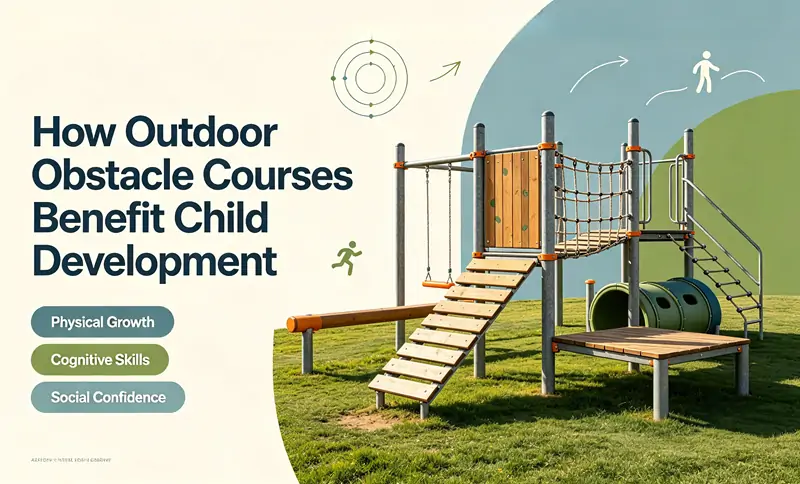
The most obvious benefit of obstacle courses is physical development. Unlike passive play equipment, obstacle courses require active, full-body engagement.
Key physical benefits:
Huaxia's outdoor obstacle courses are designed with these developmental goals in mind. Built with weather-resistant wood or composite wood and powder-coated steel, the courses remain splinter-free and safe year after year. The modular design allows for flexible arrangement, making them suitable for different age groups and skill levels.
Obstacle courses are natural problem-solving environments. Each element presents a challenge that children must figure out how to overcome.
Cognitive benefits include:
Research consistently shows that physical activity combined with cognitive challenge—exactly what obstacle courses provide—supports brain development and academic readiness. For schools looking to integrate curriculum-based learning with physical activity, obstacle courses offer a natural bridge.
Obstacle courses are often social experiences. Whether in a school setting or a public park, children typically navigate courses together.
Social and emotional benefits:
Inclusive design is increasingly important in modern playgrounds. Obstacle courses can be designed to accommodate children of different abilities, ensuring that all children can participate and benefit. Huaxia's equipment is designed with safety connectors, cushioned surfaces, and fall protection zones to create a secure environment for all users.
Not all obstacle courses are suitable for all ages. Effective course design considers the developmental stage of the intended users.
| Age Group | Typical Abilities | Suitable Obstacle Elements | Key Safety Considerations |
|---|---|---|---|
| 2–5 years | Developing balance, crawling, basic climbing | Low climbing walls, crawl tunnels, small balance beams, sensory panels | Fall height under 1 meter, soft surfaces, rounded edges |
| 5–12 years | Improved coordination, strength, sequencing | Climbing walls, rope courses, monkey bars, balance beams, agility challenges | Fall height up to 2.5 meters, impact-absorbing surfacing |
| 12+ years | Advanced strength, coordination, strategic thinking | High climbing walls, complex rope courses, fitness stations, parkour elements | Higher fall heights, more complex movements, adult supervision |
Huaxia offers specialized obstacle course solutions for different age groups. The Little Kids Outdoor Parkour Course features modular design with flexible sizes for easy arrangement, while the Kindergarten Outdoor Children Parkour Course is specially designed to encourage young children to climb and explore. Explore more outdoor obstacle course solutions for different age groups and settings.
Educational institutions worldwide are recognizing the value of obstacle courses as part of their outdoor learning environments.
Key reasons for investment:
Huaxia's commercial outdoor playground equipment is designed for a variety of markets and applications, including educational and institutional settings. Their modular obstacle course equipment features an innovative interlocking design that allows teachers and coaches to freely reconfigure the layout in minutes, creating endless new courses to keep children engaged.
When evaluating obstacle course equipment, safety should be the top priority. Reputable manufacturers design their equipment to meet international safety standards.
Key standards and certifications:
Huaxia's outdoor fitness equipment and outdoor slide products are tested by German TUV and meet EN71 and EN1176 standards. Their equipment features safety connectors, cushioned surfaces, and fall protection zones. With over 25 years of industry experience, 5,000+ installations worldwide, and 100% commercial-grade materials, Huaxia provides the reliability that schools and institutions require.
Children as young as 2 years old can begin using age-appropriate obstacle courses with low climbing elements, crawl tunnels, and simple balance activities. Huaxia offers specialized courses for different age groups, including the Little Kids Outdoor Parkour Course designed for young children.
Obstacle courses develop executive function skills—planning, sequencing, focus, and adaptability—that are foundational to academic success. They also support spatial reasoning and problem-solving abilities. Many schools integrate obstacle courses with curriculum-based learning activities.
Yes, when designed and installed according to safety standards. Look for equipment that meets EN1176 or ASTM F1487 standards, features safety connectors and cushioned surfaces, and is installed with proper fall-absorbing surfacing. Huaxia's equipment is TUV-certified and meets EN71 and EN1176 standards.
Space requirements vary by course size and complexity. A small course for young children might fit in 50–100 square meters, while a larger course for older children could require 200+ square meters. Huaxia's modular designs allow for flexible layout and easy expansion.
Yes. Huaxia specializes in tailor-made outdoor play equipment solutions. Their modular obstacle course equipment can be reconfigured and expanded with additional modules, making it adaptable to different spaces and themes.
Commercial-grade obstacle courses require minimal maintenance. Huaxia's composite wood obstacle courses are engineered from a blend of wood fibers and polymers that will not splinter, crack, or rot, and do not require annual staining or sealing. Regular inspection for loose hardware and cleaning are typically sufficient.
Outdoor obstacle courses are far more than entertainment—they are developmental tools that support physical strength, cognitive growth, and social-emotional learning. For schools, daycare centers, and community parks, they represent a strategic investment in child development that pays dividends in healthier, more confident, and more capable children.
When choosing an obstacle course, prioritize safety standards, age-appropriate design, and durable materials. Look for equipment that meets EN1176 or ASTM standards, offers modular flexibility, and is built with commercial-grade materials that can withstand heavy use and harsh weather.
If you're considering adding an obstacle course to your school, daycare, or community space, explore the available playground equipment options or learn more about outdoor obstacle course solutions. For project-specific guidance, contact the team to discuss your requirements.
Enter Your E-Mail


Yangwan Industrial Park, Qiaoxia, Yong Jia, Wenzhou, Zhejiang, China