The climate where your playground equipment will be installed is one of the most important factors in equipment selection. The same galvanized steel that performs well for 20 years in a temperate city may show corrosion at weld points within a few seasons in a coastal resort. HDPE plastic that keeps its color in Northern Europe may become brittle in extreme cold. The key is to understand the specific environmental stresses your site will face—UV radiation, salt exposure, humidity, freeze-thaw cycling—and match material properties accordingly. This guide provides a climate-based selection framework for institutional buyers.
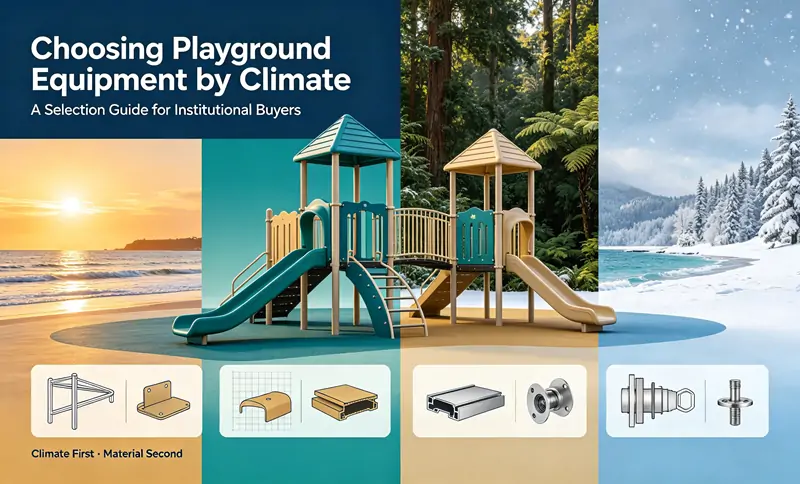
Why Climate Is the First Filter in Material Selection
Most playground equipment buyers start by comparing materials: steel vs. plastic vs. timber. But material choice should actually be the second decision. The first decision is: what will this material face in my climate?
Different climates impose different degradation mechanisms on materials:
- Photodegradation: UV radiation breaks chemical bonds in polymers and coatings, causing fading, brittleness, and cracking.
- Electrochemical corrosion: Moisture, oxygen, and electrolytes (salt, acid rain) oxidize metal components. This is most severe in coastal and humid regions.
- Biodegradation: Fungi and insects attack wood under high humidity and warm temperatures.
- Thermomechanical stress: Repeated expansion and contraction from temperature swings loosen connectors, crack welds, and destabilize foundations.
A material that resists one mechanism well may fail badly against another. This is why climate-specific selection matters more than material "quality" in the abstract.
Hot and Sunny Climates
Primary stresses: UV radiation, high surface temperatures, heat retention.
Material considerations:
- UV-stabilized HDPE is the strongest choice for components children touch frequently—slides, panels, and platforms. Quality HDPE is UV-stabilized during manufacturing and resists fading and cracking under intense sunlight. However, UV stabilization quality varies. Ask for the UV stabilization grade and warranty terms in writing—cheap HDPE can chalk and fade in 2–3 years.
- Powder-coated steel is structurally sound but can become hot in direct sunlight. If using steel, specify a light color for powder coating to reduce heat absorption, and consider shade structures over high-contact areas.
- Shade structures are not optional in hot climates. They protect children from UV exposure and keep equipment surfaces cool enough to touch.
- Avoid: Untreated timber (cracks and dries out), uncoated dark metal surfaces.
Humid and Tropical Rainy Climates
Primary stresses: Constant moisture, mold and mildew growth, accelerated corrosion.
Material considerations:
- Hot-dip galvanized steel provides effective substrate protection for structural frames. The zinc coating creates a sacrificial layer that blocks moisture and oxygen penetration. Under non-extreme conditions, a galvanized-plus-powder-coating system can extend equipment lifespan to 15–20 years.
- Composite materials (wood fiber + plastic binder) perform well in wet, humid environments because they resist rot, warping, and insect damage while maintaining a natural appearance.
- Drainage design is critical. Poor drainage leads to standing water, which promotes rust, mold growth, and insect breeding. The site should have a slight slope, and surfacing should be porous or well-drained.
- Avoid: Untreated timber in ground contact (rots quickly), steel without adequate coating maintenance.
Huaxia's after-sales service includes personalized maintenance plans based on equipment usage and characteristics, with rapid parts availability for common components.
Coastal and Salt-Air Environments
Primary stresses: Salt spray corrosion, high humidity, UV exposure, wind.
Material considerations:
- Hot-dip galvanized steel with C4/C5 marine-grade anti-corrosion treatment is the minimum specification for coastal installations. Municipal projects near saltwater have selected hot-dipped galvanized steel specifically for its enhanced corrosion resistance in coastal environments.
- 316 stainless steel (with molybdenum) is the premium option for high salt-spray zones. It resists chloride-induced corrosion where 304 stainless steel would eventually fail. The cost premium is roughly 30–60% over galvanized steel, but it eliminates repainting cycles and resists salt-air corrosion.
- HDPE is suitable for non-structural components (panels, roofs) because it does not rust. However, UV exposure combined with salt air accelerates surface degradation—specify UV-stabilized grades.
- Proximity matters: Equipment installed within 500 yards (457 meters) of a saltwater shoreline faces significantly higher corrosion risk. Standard warranties may be reduced by half or exclude corrosion damage entirely in these zones. Confirm warranty terms before purchase.
- Avoid: Standard powder-coated steel without galvanization, untreated carbon steel, low-grade stainless steel (e.g., 201 grade).
Cold and Snowy Climates
Primary stresses: Freeze-thaw cycling, snow loads, ice formation, material brittleness at low temperatures.
Material considerations:
- Galvanized steel performs well in cold climates, but specify thicker wall thickness to handle snow loads. Steel does not become brittle at low temperatures as some plastics do.
- HDPE is generally suitable, but verify the cold-temperature impact specifications. Low-quality HDPE can become brittle and crack under impact in extreme cold. Quality UV-stabilized HDPE retains flexibility across a wide temperature range.
- Timber requires careful attention in cold climates. Water enters the wood grain, freezes, and expands—constant freeze-thaw cycles result in warped, cracked wood that is structurally unsound. If using timber, specify kiln-dried, low-absorption species (such as Robinia or Larch) and ensure ground-contact points use steel shoe anchors that lift the timber off wet soil.
- Foundation depth: Posts must be installed below the frost line to remain secure during freeze-thaw cycles.
- Avoid: Untreated timber in ground contact, thin-wall steel without snow-load calculation, low-grade plastic components.
Climate-Material Selection Matrix
| Climate Type |
Primary Stress |
Recommended Structural Frame |
Recommended Surfaces/Panels |
Key Risk to Avoid |
| Hot & Sunny |
UV, heat |
Powder-coated steel (light color) |
UV-stabilized HDPE |
Dark metal surfaces, cheap non-UV HDPE |
| Humid & Tropical |
Moisture, mold |
Hot-dip galvanized steel |
Composite, HDPE |
Untreated timber, poor drainage |
| Coastal / Salt Air |
Salt corrosion |
C4/C5 galvanized steel or 316 stainless |
HDPE, marine-grade hardware |
Standard powder-coated steel, 304 stainless in high-salt zones |
| Cold & Snowy |
Freeze-thaw |
Galvanized steel (thicker wall) |
Quality HDPE, kiln-dried timber with steel anchors |
Untreated timber, thin plastic, shallow foundations |
This matrix is a starting point. Actual specification depends on the specific combination of stresses at your site—a coastal city in a cold climate faces both salt corrosion and freeze-thaw cycling, requiring a dual-specification approach.
Maintenance Implications by Climate
Climate affects not just material selection but also the maintenance schedule.
- Hot climates: Inspect UV-stabilized components for fading or surface chalking every 6 months. Check shade structures for UV degradation. Clean surfaces more frequently to remove sunscreen and sweat residue.
- Humid climates: Check drainage systems monthly during rainy seasons. Inspect metal joints for early rust signs quarterly. Clean mold and mildew from surfaces with appropriate cleaners.
- Coastal environments: Inspect for salt corrosion every 3 months. Touch up coating damage immediately—a small chip becomes a corrosion site rapidly in salt air. Fasteners and connectors require more frequent inspection than in inland settings.
- Cold climates: Conduct a post-winter full inspection each spring to check for freeze-thaw damage. Verify that foundations remain stable. Lubricate moving parts before winter to prevent ice locking.
For institutional buyers, this reduces the operational burden of climate-specific maintenance. Huaxia's commercial-grade equipment is designed for demanding environments, with material specifications available for climate-specific applications.
What to Verify Before Purchase
Use this checklist when evaluating playground equipment for your climate:
- Confirm the specific climate stresses at your site (UV index, annual rainfall, salt exposure distance, temperature range, frost depth).
- Ask the supplier for material specifications relevant to your climate—not generic "weather-resistant" claims.
- Request UV stabilization grade documentation for all plastic components.
- For coastal installations, confirm the galvanization specification (hot-dip vs. electroplated) and coating thickness.
- For cold climates, verify that foundation design accounts for local frost depth.
- Ask for the warranty terms specifically as they relate to your climate condition—corrosion exclusions, UV fading coverage, freeze-thaw damage.
- Request references from similar climate zones if available.
- Confirm that replacement parts are available for your specific climate-specified components.
Frequently Asked Questions
Q: Can standard playground equipment be used in any climate?
Standard equipment can often be adapted, but "standard" specifications are typically designed for temperate conditions. In coastal, desert, or extreme cold environments, standard powder-coated steel may corrode or degrade faster than expected. Always confirm that the equipment specification matches your climate's specific stresses.
Q: What is the best material for a coastal playground?
For structural components, hot-dip galvanized steel with C4/C5 marine-grade treatment is the minimum. For premium installations or high-salt-spray zones within 500 meters of the shoreline, 316 stainless steel is the most durable option. For non-structural components, UV-stabilized HDPE is suitable.
Q: How does UV radiation affect playground equipment?
UV radiation breaks chemical bonds in polymers, causing fading, brittleness, and surface cracking. Quality HDPE is UV-stabilized during manufacturing to resist this. Without adequate stabilization, plastic components can become structurally weakened within 2–3 years of intense sun exposure. Always request the UV stabilization grade from your supplier.
Q: Does cold weather damage playground equipment?
Cold weather itself does not damage most quality materials, but freeze-thaw cycling does. Water enters cracks or joints, freezes, expands, and causes progressive damage—especially to timber. Steel and quality HDPE handle cold temperatures well. Foundation depth below the frost line is critical for structural stability.
Q: How often should coastal playground equipment be inspected?
Coastal installations require more frequent inspection than inland sites—typically every 2–3 months for corrosion checks, compared to quarterly or semi-annually for inland playgrounds. Salt air accelerates corrosion on exposed metal, and small coating damage can become a significant corrosion site quickly.
Q: Can I install the same equipment in a desert and a coastal location?
No. Desert and coastal climates impose completely different stresses. Desert environments require UV-stabilized materials and heat-resistant surfaces. Coastal environments require corrosion-resistant metals and salt-air-rated hardware. Specifying the same equipment for both would result in premature failure in at least one location.
Conclusion
Climate is the first filter in playground equipment selection, not an afterthought. The degradation mechanisms—UV radiation, electrochemical corrosion, biodegradation, and thermomechanical stress—vary significantly by location, and material performance must be matched to the specific stresses of your site.
The most important decision is to verify climate-specific specifications before purchase. Ask for UV stabilization grades, galvanization specifications, coating thicknesses, and warranty terms that explicitly address your climate condition. Generic "weather-resistant" claims are not sufficient.
If you're planning a playground project in a challenging climate and want to discuss material specifications, review the available playground equipment options or explore commercial-grade equipment designed for demanding environments. For climate-specific guidance, contact the team to discuss your site conditions and requirements.