

How to Evaluate Playground Equipment Suppliers: A Buyer's Checklist

Sep 24, 2026

Evaluating a playground equipment supplier requires looking beyond the product catalog and price quote. A reliable supplier should demonstrate verifiable manufacturing capability, valid safety certifications, responsive after-sales support, and a track record of completed projects. The most common mistake buyers make is selecting a supplier based on price alone—without verifying factory capability, certification authenticity, or parts availability. This guide provides a practical evaluation framework covering five key dimensions: manufacturing capability, safety certification, design and customization, after-sales support, and project references.
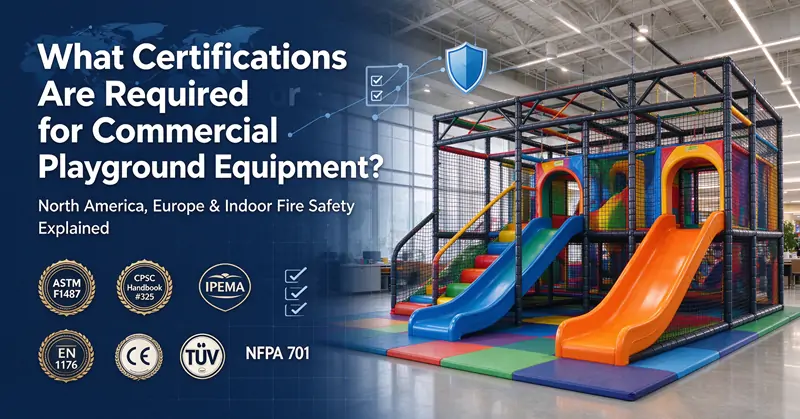
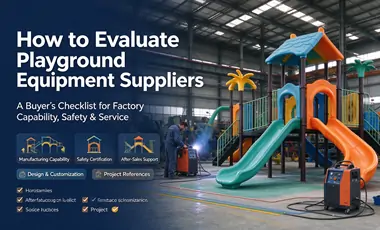
Commercial playground factory and finished play structure, supplier assessment including production workshop, safety certificates, custom design, after sales service and project case references

Why Supplier Evaluation Matters

Playground equipment is a long-term investment. Unlike consumer products, commercial playground equipment is expected to withstand years of heavy use, weather exposure, and safety scrutiny. The supplier you choose affects not only the initial product quality but also:

  • Warranty coverage and claims process: Will the supplier honor warranty claims promptly?
  • Parts availability: Can replacement parts be sourced quickly when needed?
  • Technical support: Will the supplier provide installation guidance and maintenance advice?
  • Compliance documentation: Can the supplier provide the certification documents your local authority requires?

A supplier that performs well on all five evaluation dimensions reduces project risk substantially. A supplier that performs poorly on even one dimension can create problems that persist for years.

Dimension 1: Manufacturing Capability

The first question to ask is whether the supplier actually manufactures the equipment or simply resells it. This affects quality control, customization capability, and pricing transparency.

What to verify:

  • Factory location and size: A supplier with its own production facility has direct control over quality and production timelines. Huaxia operates a manufacturing base of over 60,000 square meters in Yongjia, Wenzhou, Zhejiang.
  • Production equipment: Ask about the types of machinery used—CNC cutting, welding, powder coating lines, and plastic molding equipment indicate a full-capability manufacturer.
  • In-house vs. outsourced processes: Which processes are done in-house and which are outsourced? A higher in-house ratio generally means better quality control.
  • Production capacity: Can the supplier handle your project size within your required timeline? Standard production runs take approximately 15–30 days depending on size and quantity.
  • Quality control process: Ask about incoming material inspection, in-process checks, and final inspection before shipment.

Red flags:

  • No factory address or unwillingness to share factory photos/videos
  • Vague answers about production processes
  • Extremely low prices that suggest substandard materials

Dimension 2: Safety Certification and Compliance

Safety certification is non-negotiable for commercial playground equipment. However, not all certifications are equal, and some suppliers may claim compliance without providing verifiable documentation.

Key certifications to verify:

  • EN1176: European standard for playground equipment safety
  • EN71: European standard for toy safety
  • ASTM F1487: US standard for public playground equipment
  • TUV: Independent testing and certification body

Huaxia's outdoor fitness equipment and outdoor slide products are tested by German TUV and meet EN71 and EN1176 standards. The company also holds 5 invention patents, 27 utility model patents, and over 100 appearance patents. Review their quality certifications for more detail.

What to ask for:

  • Copies of valid certification documents (not expired)
  • Test reports from accredited third-party laboratories
  • The scope of certification—does it cover the specific product you're purchasing?
  • Whether certification applies to the materials or the finished product

What to watch for:

  • Suppliers who claim "EN1176 compliant" but cannot provide a test report
  • Certifications that are expired or cover a different product category
  • Reliance on self-declaration without third-party verification

Dimension 3: Design and Customization Capability

For many buyers, standard products are not sufficient. The supplier's design and customization capability determines whether your specific requirements can be met.

What to evaluate:

  • In-house design team: Does the supplier have dedicated designers, or do they outsource design work?
  • Customization scope: Can they modify dimensions, colors, themes, and configurations? Huaxia specializes in tailor-made outdoor play equipment and has completed over 1,000 cultural product projects across outdoor cultural tourism, real estate communities, parent-child parks, and kindergarten education.
  • Design process: How does the supplier handle design requests? Do they provide 3D renderings, technical drawings, and material specifications before production?
  • Communication efficiency: How quickly does the supplier respond to design questions and revisions?

A practical test: Provide a specific customization request (e.g., a non-standard dimension or a themed design element) and observe how the supplier responds. A capable supplier will ask clarifying questions and provide a detailed proposal. A reseller will likely deflect or give vague answers.

Dimension 4: After-Sales Support and Parts Availability

After-sales support is where many suppliers fall short. The quality of after-sales service directly affects your total cost of ownership and the equipment's usable lifespan.

What to evaluate:

  • Response time: How quickly does the supplier respond to service requests? Huaxia's service team of more than 50 people provides rapid response through service hotlines, email, and online messaging.
  • On-site support: Can the supplier send repair personnel to the site? Huaxia's repair personnel can arrive at the site within 48 to 72 hours.
  • Parts availability: Does the supplier maintain a stock of common replacement parts? Huaxia maintains over 500 types of common parts in stock, with regular parts typically delivered within about 2 days.
  • Maintenance planning: Does the supplier offer personalized maintenance plans based on equipment usage and characteristics?
  • Warranty terms: What does the warranty cover, and what is the claims process? Are there exclusions for climate conditions or usage intensity?

Explore Huaxia's after-sales support capabilities for more detail.

Dimension 5: Project References and Track Record

A supplier's past projects are the most reliable indicator of their capability. Ask for references from projects similar to yours in scale, application, and climate.

What to evaluate:

  • Similar projects: Has the supplier completed projects for schools, parks, or commercial spaces similar to yours?
  • Climate similarity: If your project is in a coastal or extreme climate, ask for references from similar environments.
  • Project scale: Has the supplier handled projects of comparable size and complexity?
  • Client feedback: Can the supplier provide contactable references or case study documentation?

Huaxia's completed projects include installations across 100+ countries and regions, with solutions for parks, schools, commercial spaces, and daycare centers.

How to verify references:

  • Request project photos and, if possible, site visit access
  • Ask specific questions about the project timeline and any challenges encountered
  • Contact references directly if permitted

Supplier Evaluation Checklist

Use this checklist to systematically evaluate each supplier:

Manufacturing Capability

  • Factory location and size verified
  • Production equipment confirmed (CNC, welding, coating, molding)
  • In-house vs. outsourced processes clarified
  • Production capacity matches project timeline
  • Quality control process documented

Safety Certification

  • EN1176 or ASTM F1487 certification verified
  • TUV or equivalent third-party test reports provided
  • Certification scope covers the specific product
  • Certificates are valid and not expired
  • Patents and intellectual property documented

Design and Customization

  • In-house design team confirmed
  • Customization scope and capabilities discussed
  • 3D renderings and technical drawings provided
  • Design revision process clarified
  • Communication responsiveness tested

After-Sales Support

  • Response time commitment documented
  • On-site support availability confirmed
  • Parts availability and delivery time verified
  • Maintenance planning offered
  • Warranty terms reviewed (coverage, exclusions, claims process)

Project References

  • Similar projects in similar applications identified
  • References from similar climate conditions requested
  • Project scale and complexity comparable
  • Client feedback or case studies available

Common Mistakes in Supplier Evaluation

Mistake 1: Evaluating on price alone. The lowest quote often reflects lower material grades, fewer safety features, or limited after-sales support. Compare total cost of ownership, not just purchase price.

Mistake 2: Accepting certification claims without verification. Ask for test reports from accredited laboratories. "EN1176 compliant" without a test report is not verifiable.

Mistake 3: Skipping the factory audit. If possible, visit the factory or request a video tour. This reveals more about capability than any catalog.

Mistake 4: Ignoring after-sales terms. A supplier with excellent products but poor after-sales support will create problems after installation.

Mistake 5: Not checking parts availability. If replacement parts take months to arrive, equipment downtime becomes a serious operational issue.

Frequently Asked Questions

Q: How do I verify that a supplier's certifications are valid?

Request copies of the certification documents and test reports. Check the issuing body (e.g., TUV, SGS), the certificate number, the expiration date, and whether the certified product matches what you're purchasing. Contact the issuing body directly if you need to verify authenticity.

Q: Should I visit the supplier's factory before placing an order?

A factory visit is strongly recommended for large projects. If travel is not possible, request a live video tour of the production facility. This allows you to see the actual manufacturing environment, equipment, and quality control processes.

Q: What is a reasonable response time for after-sales support?

For urgent issues, a response within 24–48 hours is reasonable. For on-site support, a commitment to arrive within 48–72 hours is typical for established suppliers. Response times should be documented in the contract.

Q: How many supplier references should I check?

For a significant project, aim to check at least 2–3 references. Prioritize references from projects similar to yours in application, scale, and climate. Ask specific questions about the supplier's responsiveness and problem-solving.

Q: What should I do if a supplier cannot provide certification documents?

If a supplier cannot provide valid certification documents for commercial playground equipment, this is a serious red flag. Safety compliance is a baseline requirement for institutional projects. Consider alternative suppliers who can provide verifiable documentation.

Q: How do I compare suppliers when their quotes have different cost breakdowns?

Request itemized quotes that separate equipment cost, shipping, installation, and any additional services. Ask each supplier to clarify what is included and what is not. Then compare on a like-for-like basis, factoring in expected lifespan, maintenance requirements, and parts availability.

Conclusion

Evaluating playground equipment suppliers is a structured process, not a subjective judgment. By systematically assessing manufacturing capability, safety certification, design capability, after-sales support, and project references, you can make an objective comparison and reduce project risk.

The most important principle is verification: don't accept claims at face value. Ask for factory documentation, test reports, reference contacts, and written after-sales commitments. A supplier that is transparent and responsive during the evaluation phase is likely to remain so during the project and beyond.

For buyers ready to begin the evaluation process, review Huaxia's quality certifications or explore their after-sales support capabilities. Completed projects provide additional reference material. For project-specific questions, contact the team to discuss your requirements.

Here Are The Related Products You Want To See!

GET A QUOTE

+86 18968876888

+86 18968876888

Vasia toys@huaxiatoys.com

GET IN TOUCH NOW