Oct 08, 2026



Playground safety surfacing is not a cosmetic choice—it is a critical safety system. The surface beneath and around playground equipment determines how much impact a child experiences during a fall, and it is the single most important factor in reducing fall-related injuries. Choosing the wrong surfacing type, or installing it at insufficient depth, can compromise safety even when the equipment itself meets all standards. This guide explains the key concepts, material options, and selection criteria for playground safety surfacing.
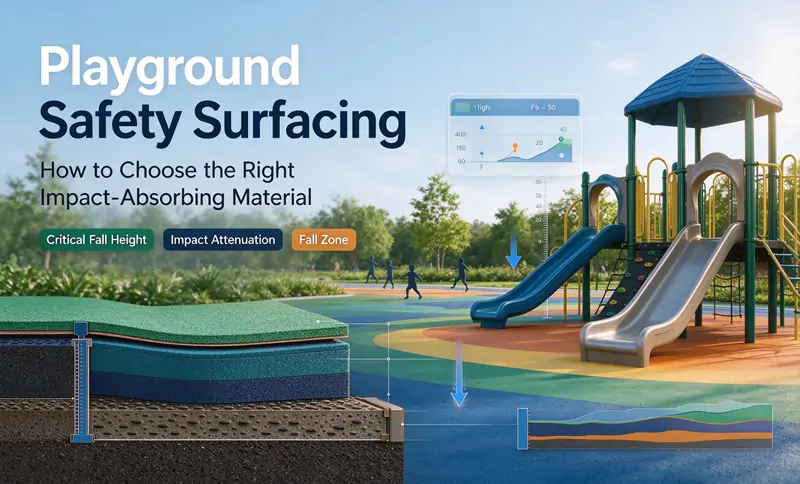
Falls are the leading cause of playground-related injuries. According to safety research, the majority of serious playground injuries involve falls to the surface. The surface material and its depth determine the deceleration distance during impact—the more gradually a fall is absorbed, the lower the risk of injury.
Safety standards such as EN1176 and ASTM F1292 specify how surfacing must perform. EN1176 references impact attenuation requirements based on the equipment's critical fall height. ASTM F1292 defines the test method for measuring a surface's impact-absorbing performance.
Key principle: The surfacing must be rated for the critical fall height of the equipment it covers. A surface that is adequate for a 1-meter fall may be insufficient for a 2.5-meter fall.
Critical fall height (CFH) is the maximum height from which a fall is considered to be reasonably safe when the correct surfacing is installed. It is not the same as the platform height—it is determined by the equipment design and specified by the manufacturer.
How to use CFH:
Fall zone dimensions are specified in EN1176 and ASTM standards. As a general rule, the fall zone extends at least 1.5 to 2 meters beyond the equipment's edge, depending on the equipment type and height.
There are two main categories: loose-fill and unitary.
Loose-fill surfacing:
| Material | Advantages | Considerations | Typical CFH Range |
|---|---|---|---|
| Engineered wood fiber (EWF) | Lower initial cost, natural appearance | Requires raking and topping up; can compact; needs drainage | Up to 3.0 m (at sufficient depth) |
| Sand | Low cost, readily available | Poor impact attenuation at shallow depth; attracts animals; requires frequent raking | Limited to low fall heights |
| Pea gravel | Low cost, good drainage | Not suitable for young children; can be a choking hazard; requires regular raking | Moderate fall heights with sufficient depth |
| Shredded rubber | Good impact absorption, less compaction than EWF | Higher cost than EWF; can get hot in sun | Up to 3.0 m or higher |
Unitary surfacing:
| Material | Advantages | Considerations | Typical CFH Range |
|---|---|---|---|
| Rubber tiles | Low maintenance, consistent performance, good for accessibility | Higher initial cost; can get hot; requires proper sub-base | Up to 3.0 m or higher |
| Poured-in-place rubber (PIP) | Seamless, customizable, excellent accessibility | Highest initial cost; requires professional installation; can be damaged by vandalism | Up to 3.0 m or higher |
| Artificial grass with shock pad | Aesthetic appeal, good accessibility | Moderate to high cost; requires specific maintenance | Varies by system |
For institutional buyers, the choice often comes down to a trade-off between initial cost and long-term maintenance. Loose-fill materials cost less upfront but require ongoing replenishment. Unitary surfaces cost more initially but offer lower maintenance and consistent performance. If you are coordinating surfacing with the equipment purchase, it helps to review commercial-grade equipment specifications at the same time, since fall heights and fall zone dimensions directly determine surfacing requirements.
Selection depends on four factors: critical fall height, climate, maintenance capacity, and accessibility requirements.
Step 1: Determine the critical fall height.
Review the equipment specifications. The manufacturer should provide the CFH for each component. The surfacing you choose must be rated for the highest CFH in the play area.
Step 2: Match material to CFH.
Use the manufacturer's or supplier's performance data to select a surfacing material and thickness that meets or exceeds your CFH. Do not assume—verify with test data or certification.
Step 3: Consider climate.
Step 4: Assess maintenance capacity.
Step 5: Verify compliance.
Ask the surfacing supplier for test reports or certification demonstrating that the product meets the required CFH. EN1176 and ASTM F1292 specify the test methods. A reputable supplier will provide this documentation.
Surfacing and equipment maintenance should be planned together. Huaxia's after-sales service includes maintenance guidance that can help buyers plan for long-term surfacing care alongside equipment maintenance.
Surfacing installation is not a DIY task. It requires proper sub-base preparation, correct depth, and—for unitary surfaces—professional installation.
For loose-fill:
For unitary:
Installation errors—such as insufficient depth, poor drainage, or inadequate sub-base—can reduce the surfacing's performance and lead to premature failure.
| Surfacing Type | Routine Maintenance | Frequency | Long-Term Replacement |
|---|---|---|---|
| Engineered wood fiber | Rake, top up, remove debris | Monthly (high traffic) | Top up annually; replace every 3–5 years |
| Sand | Rake, sift, top up | Weekly to monthly | Replace every 2–3 years |
| Pea gravel | Rake, remove debris, top up | Monthly | Replace every 3–4 years |
| Rubber tiles | Clean, inspect for damage | Quarterly | Replace damaged tiles as needed; full replacement 10–15 years |
| Poured-in-place rubber | Clean, inspect for cracks | Quarterly | Repair as needed; full replacement 10–15 years |
Loose-fill materials require more frequent routine maintenance but lower initial cost. Unitary surfaces require less routine maintenance but higher upfront investment and professional repair for damage.
Surfacing cost is often underestimated in playground budgets. It can account for 15–25% of total project cost, depending on the material and site conditions.
Factors that affect cost:
When comparing quotes, request itemized pricing that separates material cost, site preparation, and installation. Compare total cost over the expected lifespan, not just initial price. Reviewing completed projects can also help you understand how different surfacing choices perform in real-world installations.
Mistake 1: Choosing based on price alone. The cheapest material may require frequent topping up or replacement, resulting in higher long-term cost.
Mistake 2: Ignoring critical fall height. Installing surfacing that is not rated for the equipment's CFH creates a safety hazard.
Mistake 3: Underestimating the fall zone area. The surfacing must cover the entire fall zone, not just the equipment footprint.
Mistake 4: Skipping drainage. Poor drainage leads to compaction, degradation, and premature failure.
Mistake 5: Assuming all rubber is the same. Rubber tiles, PIP, and shredded rubber have different performance characteristics and costs.
The critical fall height of the equipment. The surfacing material and thickness must be rated for the highest fall height in the play area. Safety standards such as EN1176 and ASTM F1292 specify the requirements.
Neither is universally better. Rubber (unitary) surfacing offers lower maintenance and better accessibility but costs more upfront. Engineered wood fiber (EWF) costs less initially but requires regular raking and topping up. The best choice depends on your budget, maintenance capacity, and accessibility requirements.
Depth depends on the material type and the critical fall height. For example, EWF may require 30 cm depth for a 2.5-meter fall height, while rubber tiles may require a specific thickness rated for that height. Always follow the manufacturer's performance data and verify with test reports.
Loose-fill materials can be installed by facility staff with proper guidance. Unitary surfaces—rubber tiles and poured-in-place—require professional installation to ensure correct thickness, sub-base preparation, and impact performance.
Loose-fill materials typically need topping up annually and full replacement every 3–5 years, depending on usage. Unitary surfaces generally last 10–15 years with proper maintenance, though individual tiles may need replacement earlier if damaged.
Yes. Unitary surfaces (rubber tiles, PIP) provide better accessibility for wheelchairs and mobility aids than loose-fill materials. If your playground serves children with disabilities, unitary surfacing may be required or strongly recommended.
Playground safety surfacing is a critical safety system, not an afterthought. The right choice depends on the equipment's critical fall height, your climate, your maintenance capacity, and your accessibility requirements.
The most important principle is to verify performance. Do not assume that a material is suitable based on its general description. Ask for test data, confirm the CFH rating, and ensure that the surfacing extends across the entire fall zone.
For buyers evaluating equipment and surfacing together, review the available playground equipment options or explore commercial-grade equipment designed for institutional use. Completed projects provide reference for how equipment and surfacing work together. For project-specific guidance, contact the team to discuss your requirements.
Enter Your E-Mail


Yangwan Industrial Park, Qiaoxia, Yong Jia, Wenzhou, Zhejiang, China