Sep 09, 2026




Public playgrounds are evolving from generic equipment collections into thoughtfully designed community destinations. The shift reflects a fundamental change in how communities view play spaces: not as afterthoughts tucked into available land, but as central gathering places that define neighborhood identity, serve diverse age groups, and create lasting social value.
This article examines why custom-designed playgrounds are becoming the preferred choice for community spaces, what factors drive this transition, and how planners can make informed decisions when developing new play areas.
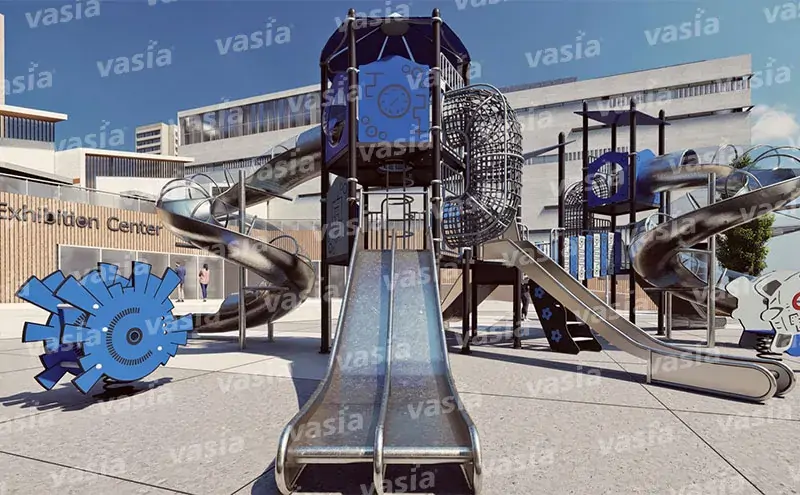
For decades, playgrounds followed a predictable pattern: a swingset, a slide, a few climbing structures, all arranged on a standard layout. These spaces served a basic function but rarely reflected the character of the communities they served.
Today, that model is shifting. Communities increasingly recognize that playgrounds can do more than provide recreation—they can foster social connection, reinforce local identity, and attract families and visitors. Modern playgrounds are being reimagined by architects and planners as "community hubs" that serve not just children but entire neighborhoods.
This evolution is driven by several factors:
• Demographic diversity. Communities are composed of families with children of different ages, seniors seeking gentle activity, and caregivers who need comfortable spaces to supervise. A one-size-fits-all approach no longer meets these varied needs.
• Placemaking priorities. Municipalities and developers understand that distinctive public spaces increase property values, support local businesses, and build community pride. Generic equipment cannot deliver this differentiation.
• Inclusive design expectations. Communities expect play spaces that welcome children of all abilities. Inclusive design requires thoughtful planning that standard equipment packages rarely provide.
A custom playground differs from a standard equipment package in several fundamental ways:
| Aspect | Standard Equipment | Custom Design |
|---|---|---|
| Layout | Fixed configurations | Adapted to site shape, topography, and existing features |
| Theme | Generic | Reflective of local culture, history, or natural environment |
| Age targeting | Broad range | Tailored to specific community demographics |
| Material selection | Standard options | Chosen based on local climate and usage patterns |
| Inclusive features | Limited | Integrated from the design phase |
| Future expandability | Difficult | Designed for modular growth |
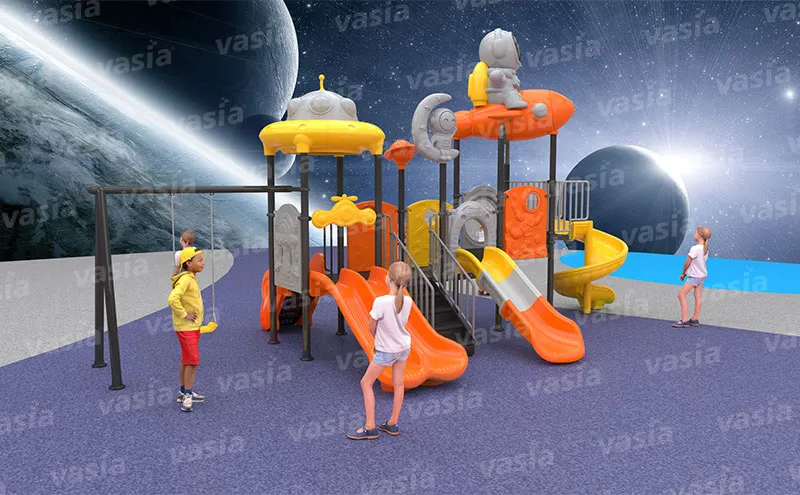
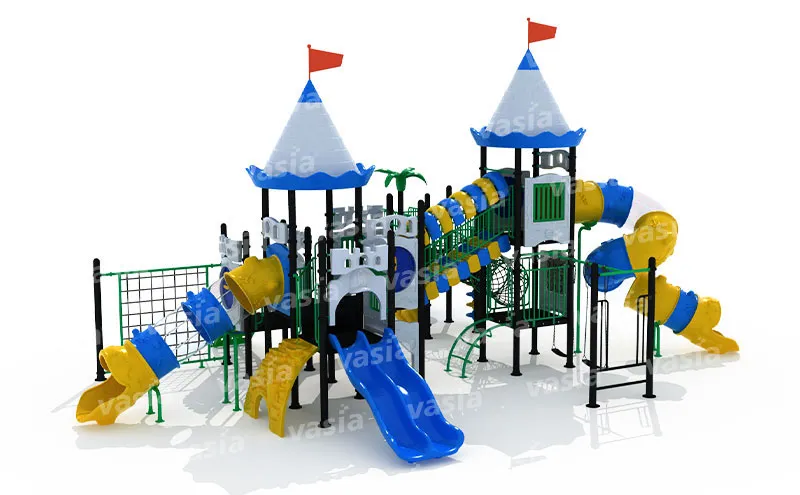
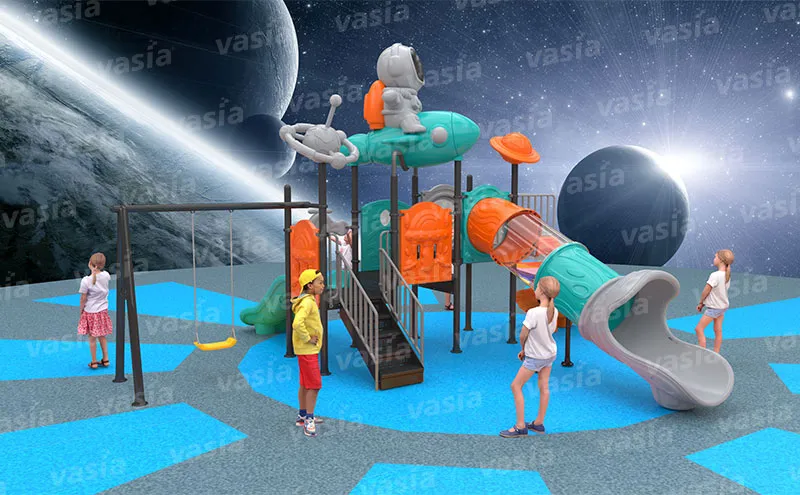
The custom approach begins not with a catalog but with a site assessment and community input process. This collaborative design phase—which may include 3D rendering services to visualize the final result—ensures the finished space meets actual community needs rather than forcing a community to adapt to prefabricated equipment.
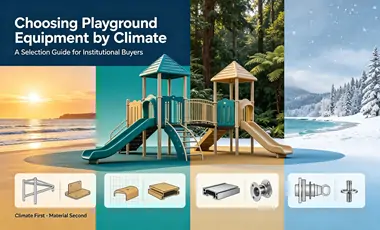
One of the most significant advantages of custom playground development is the ability to select materials specifically suited to local conditions. Different environments demand different material choices, and getting this wrong can dramatically affect durability and safety.
Galvanized steel remains a foundational material for structural components. It offers strength for tall structures and large spans. For coastal environments, however, standard galvanization may not provide sufficient corrosion resistance, making marine-grade aluminum a better option.
HDPE (High-Density Polyethylene) is widely used for decks, activity panels, and colorful components. Its UV stability makes it suitable for sunny climates, and its color options allow for vibrant, engaging designs. Some manufacturers now incorporate recycled HDPE content, supporting sustainability goals.
Stainless steel offers superior corrosion resistance and is often specified for hardware and components in high-humidity or coastal areas.
LLDPE (Linear Low-Density Polyethylene) is commonly used for roto-molded plastic parts such as slides and climbing elements. Its impact resistance and temperature tolerance make it well-suited for outdoor applications.
For communities in challenging environments—coastal areas with salt air, regions with extreme temperature swings, or high-UV locations—the ability to specify materials accordingly is not a luxury but a necessity. Available equipment options for different applications can help illustrate how material choices vary by setting.
Any playground intended for public use must meet applicable safety standards. The two primary international frameworks are:
ASTM F1487 – The American standard for public playground equipment, covering safety and performance specifications for equipment used by children.
EN 1176 – The European standard, consisting of multiple parts that cover general safety requirements as well as specific equipment types.
These standards address critical safety factors including:
• Entanglement and entrapment hazards
• Fall heights and impact-attenuating surfacing
• Protrusion and sharp edge prevention
• Structural integrity and anchoring
• Age-appropriate design considerations
When sourcing equipment from international suppliers, buyers should verify that products meet the appropriate standards for their region. This is particularly important for custom projects where designs may deviate from standard configurations. Custom Playground equipment can help you understand compliance requirements in more detail.
Custom playgrounds represent significant investments, and their long-term value depends on proper maintenance. A structured inspection program helps protect both the investment and the children who use the equipment.
Daily visual inspections should check for obvious damage, broken components, or hazardous conditions.
Monthly inspections should include lubrication of moving parts, checking for rust or corrosion, inspecting welds and joints, and examining anchoring systems.
Annual inspections should be conducted by qualified playground inspectors who can identify issues that routine checks might miss.
Equipment typically has a service life of approximately 20 years before significant replacement is needed. Regular maintenance can help achieve or even extend this lifespan.
For custom equipment, maintenance planning should begin at the design stage. Consideration of accessibility for inspections, availability of replacement parts, and the durability of specified materials all influence long-term maintenance costs. Modular equipment configurations and maintenance requirements can offer insights into design choices that simplify ongoing care.
Even well-intentioned community playground projects can encounter issues. Here are frequent pitfalls:
| Mistake | Consequence | Prevention |
|---|---|---|
| Insufficient site analysis | Equipment doesn't fit the space | Conduct thorough site survey before design |
| Overlooking age segregation | Older children dominate, younger children excluded | Design distinct zones for different age groups |
| Ignoring shade needs | Equipment becomes too hot for summer use | Integrate shade structures or choose heat-resistant materials |
| Inadequate surfacing planning | Increased injury risk from falls | Specify and budget for appropriate impact-attenuating surfacing |
| No maintenance budget | Rapid deterioration and safety issues | Allocate ongoing maintenance funds from project start |
Custom playgrounds are not the right solution for every situation. The decision depends on several factors:
Space constraints. Unusual site shapes, sloped terrain, or existing features that must be preserved often make custom design the only practical option.
Community identity goals. If the playground is intended to reflect local culture, history, or environmental character, customization delivers what standard equipment cannot.
Specific demographic needs. Communities with unusual age distributions or specific inclusive design requirements benefit from tailored solutions.
Budget considerations. While custom projects may have higher upfront costs, they can deliver better long-term value through improved durability, reduced maintenance, and higher community usage.
For many communities, a hybrid approach works well: starting with proven modular components and customizing layout, colors, and selected features to create a distinctive result.
Standard equipment comes in fixed configurations with predetermined layouts and color schemes. Custom equipment is designed specifically for a particular site, community, and set of requirements—from layout and theme to material selection and inclusive features.
Project timelines vary significantly based on complexity, but typically range from several months to over a year. Factors include design iteration, material sourcing, manufacturing lead times, and site preparation. Buyers should confirm timelines with their equipment provider early in the process.
Coastal environments require materials with high corrosion resistance. Marine-grade aluminum for structural components, stainless steel for hardware, and UV-stabilized HDPE or LLDPE for plastic parts are recommended. Standard galvanized steel may require additional protective coatings in salt-air conditions.
A comprehensive inspection program includes daily visual checks, monthly detailed inspections, and annual inspections by qualified playground inspectors. The frequency may vary based on usage levels, equipment type, and local regulations.
Yes, if designed with expandability in mind. Modular design approaches allow for future additions without requiring complete replacement. This should be discussed during the initial design phase to ensure compatibility.
For public playgrounds in North America, ASTM F1487 is the primary standard. For Europe and many other regions, EN 1176 applies. Buyers should confirm which standards apply in their location and verify that their equipment supplier can demonstrate compliance.
Custom playgrounds are becoming the future of community spaces because they offer what standardized equipment cannot: the ability to reflect local identity, serve diverse populations, adapt to specific sites, and deliver lasting value through thoughtful material selection and design.
For communities planning new play spaces, the key is to begin with clear objectives—understanding the demographics to be served, the site constraints, and the desired community outcomes—then work with an experienced partner who can translate those goals into a safe, durable, and engaging environment.
Browse our Custom Playground Equipement collection to see how different approaches might fit your community's needs.
Enter Your E-Mail


Yangwan Industrial Park, Qiaoxia, Yong Jia, Wenzhou, Zhejiang, China