Oct 20, 2026




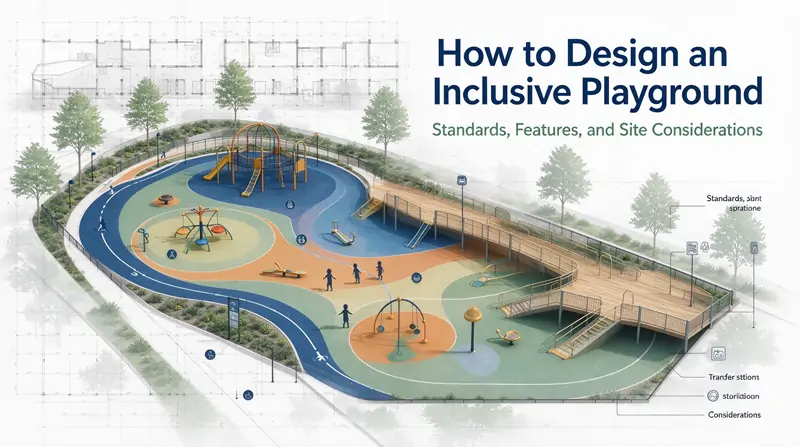
Designing an inclusive playground requires more than adding a wheelchair-accessible swing. True inclusion means every child—regardless of mobility, sensory processing, or cognitive ability—can reach, enter, and participate in play alongside peers. The key is to address inclusion at the design stage: verify accessible routes per ASTM F1487, select unitary surfacing that supports mobility aids, incorporate ground-level play components with sensory variety, and provide transfer systems for elevated structures. This guide covers the standards, features, and site decisions that determine whether your playground equipment installation is genuinely inclusive.
Inclusive design sits at the intersection of two types of requirements: safety standards and accessibility guidelines.
EN1176 is the European safety standard for playground equipment. It specifies fall zones, entrapment prevention, and structural integrity. It does not prescribe detailed accessibility requirements, but its safety provisions—such as reachable handholds and non-slip surfaces—support accessible use.
ASTM F1487 is the US safety standard. Its accessibility section establishes a key principle: when a play area's protective surfacing is rated as inaccessible, at least one accessible route must be provided from the use zone perimeter to the play event. When multiple identical play activities exist, only one must meet accessibility requirements. This means inclusion can be phased: you do not need every component to be accessible, but the play area as a whole must offer a meaningful accessible experience.
ADA (Americans with Disabilities Act) goes further, defining specific reach ranges, maneuvering clearances, and ground-level play component distribution requirements. Many jurisdictions outside the US use ADA as a reference point even where it is not legally binding.
The practical takeaway: verify which accessibility framework applies to your project, then design to the higher standard where feasible. A supplier that understands both EN1176 and ASTM F1487 can help you identify where inclusion is mandatory and where it is a design choice.
Universal design is not a single product feature—it is a set of principles applied across the entire play environment.
Equitable use: The same play experience should be available in multiple ways. Instead of one slide accessible only by stairs, provide a ground-level play panel with similar sensory feedback. Instead of one sand table at standing height, include a wheelchair-accessible table at the correct reach range.
Flexibility in use: Components should accommodate different postures and abilities. A transfer platform allows a child to move from a wheelchair to an elevated deck. A ramp provides an alternative to stairs. A sensory wall can be explored by touch, sound, or visual contrast depending on the child's needs.
Simple and intuitive use: Wayfinding should be obvious. Contrasting ground markers help visually impaired children navigate. Pictogram signage supports children who cannot read. Consistent color coding helps children with cognitive disabilities understand what each area is for.
Tolerance for error: Safety features should not create new barriers. Fall zones, surfacing depth, and protective barriers must be designed so that a child using a mobility aid is not excluded from the protective system.
Size and space for approach and use: ASTM F1487 specifies that a wheelchair must have a space of 30 by 43 inches at a play event, without reducing the accessible route below 36 inches in width. These dimensions should inform the layout of every ground-level play component.
The accessible route is the backbone of an inclusive playground. If a child cannot reach the play components, no amount of accessible equipment will matter.
Key requirements to verify:
Common mistake: Treating the accessible route as a separate "wheelchair path" alongside the main playground. Inclusive design integrates the accessible route into the primary circulation so that all children use the same space.
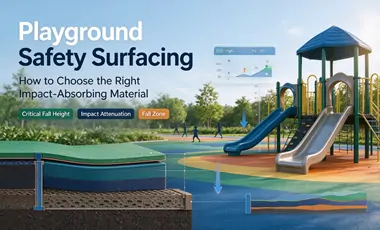
Accessible surfacing is where inclusive playgrounds most often fail. Loose-fill materials like engineered wood fiber (EWF) can meet accessibility standards when properly maintained at sufficient depth, but they compact, displace, and lose their rating under heavy use and weather.
Unitary surfacing (poured-in-place rubber, rubber tiles) performs best for accessibility because it is firm, stable, and seamless. Poured-in-place rubber is widely regarded as offering the strongest combination of fall protection, drainage, and accessible surface quality. Rubber tiles offer similar performance and can be replaced tile-by-tile if damaged.
Engineered wood fiber is cost-effective and meets ASTM F1292 fall standards, but it requires a minimum maintained depth—often 12 inches or more depending on fall height—and must be raked and topped up regularly. If maintenance resources are limited, the surface will not remain accessible.
Critical verification: Ask the surfacing supplier for documentation that the installed system meets both the required critical fall height (ASTM F1292 or EN1177) and the applicable accessibility standard. These are two separate performance requirements, and a material can meet one without the other.
Inclusive equipment is not a separate product category—it is a set of features integrated into the overall play structure.
Ground-level play components are the foundation of inclusion. These include accessible sand tables, sensory panels, tactile play walls, musical elements, and ground-level crawl tunnels. ASTM and ADA guidance requires that ground-level play components be distributed throughout the play area—not clustered in a single "accessible zone"—so that children using mobility aids can play alongside peers at multiple locations.
Transfer systems allow children to move from a wheelchair onto an elevated play structure. A transfer platform should be at a height that matches the wheelchair seat, with grab bars and a clear transfer space. Transfer systems are most valuable when they connect to elevated components that offer a distinct play experience—a slide, a climbing challenge, or a lookout deck.
Ramps provide an alternative to transfer for children who cannot transfer independently. Ramps are more inclusive than transfer systems for some users, but they require careful design: slope, handrails, edge protection, and landing spaces all affect usability.
Sensory variety supports children with different sensory processing needs. High-contrast colors, tactile textures, auditory elements, and quiet retreat spaces allow children to regulate sensory input. A playground that is visually loud and physically chaotic may exclude a child with autism even if every component is technically accessible.
Huaxia's inclusive configurations integrate ground-level sensory panels, transfer-ready platforms, and modular layouts that can be adapted to different site conditions. Review the available commercial-grade equipment to see how these features are configured.
Use this checklist during the design phase:
Not exactly. Accessibility focuses on removing physical barriers—routes, surfaces, and reach ranges—so that a child can physically reach and use equipment. Inclusion goes further: it ensures that the play experience itself is equitable, that children of different abilities can play together, and that sensory and cognitive needs are considered. An accessible playground is the baseline; an inclusive playground is the goal.
No. ASTM F1487 clarifies that when multiple identical play activities are provided, only one must meet accessibility requirements. Inclusion is assessed at the play area level: the overall experience must offer meaningful accessible play opportunities. This allows budget to be concentrated on the components that provide the greatest inclusive value.
Unitary surfacing—poured-in-place rubber or rubber tiles—performs best for accessibility because it is firm, stable, and seamless. Engineered wood fiber can meet accessibility standards if maintained at sufficient depth, but it requires consistent raking and topping up. The right choice depends on maintenance capacity and budget.
Generally, 36 inches minimum for a single wheelchair, with wider passing spaces where routes intersect. A wheelchair space of 30 by 43 inches should be provided at play events without narrowing the route below 36 inches. Local accessibility codes may specify different dimensions—verify the applicable standard for your jurisdiction.
In many cases, yes. Common retrofits include replacing loose-fill surfacing with unitary surfacing on key routes, adding a transfer platform to an existing structure, and installing ground-level sensory panels at accessible heights. A site assessment can identify which retrofits provide the greatest inclusion benefit for the cost.
Request documentation that the specific product meets the applicable standard—ASTM F1487 for accessible routes, ASTM F1292 for surfacing impact attenuation, or ADA for reach ranges. Ask for test reports from accredited laboratories, and confirm that the certification covers the product configuration you are purchasing.
Designing an inclusive playground is a process of removing barriers at every layer: the route that gets a child to the equipment, the surface that supports a mobility aid, the transfer system that opens access to elevated play, and the sensory environment that determines whether a child can regulate and engage.
The most important principle is to verify, not assume. Confirm the applicable accessibility framework, request documentation for surfacing and route performance, and distribute accessible play components throughout the play area rather than isolating them. Inclusion is not a product you buy—it is a design outcome you plan for. If you need design-stage guidance, Huaxia's after-sales service team can assist with inclusive configurations.
Review completed projects to see how inclusive features are integrated in practice, or contact the team to discuss your specific site conditions and requirements.

Enter Your E-Mail


Yangwan Industrial Park, Qiaoxia, Yong Jia, Wenzhou, Zhejiang, China