Sep 18, 2026



Planning an outdoor playground is more than picking equipment from a catalog. A well-planned playground must balance safety, durability, age-appropriateness, and budget—while fitting the physical constraints of your site. The key is to follow a systematic planning process: start with a thorough site assessment, then define user needs, review safety standards, select suitable materials, and plan for long-term maintenance. This guide walks you through each step so you can make informed decisions before you buy.
Before you consider any equipment, you need to understand your site. A playground that looks perfect in a brochure may not work on your actual ground.
Key site factors to evaluate:
Pro tip: Take photos and measurements of your site before you start researching equipment. This will save time when you discuss options with suppliers.
Different age groups need different equipment. A playground for toddlers is very different from one designed for teenagers.
Age group categories to consider:
| Age Group | Typical Equipment Needs | Key Safety Considerations |
|---|---|---|
| 6–23 months | Low platforms, small slides, sensory panels | Fall height under 1 meter, soft surfaces |
| 2–5 years | Small slides, crawl tunnels, swing sets, sand play | Fall height under 1.5 meters, no sharp edges |
| 5–12 years | Taller slides, climbing structures, obstacle courses, multi-play systems | Fall height up to 2.5 meters, impact-absorbing surfacing |
| 12+ years | Challenge courses, fitness stations, adventure elements | Higher fall heights, more complex movements |
Most school and public park playgrounds serve multiple age groups. In that case, consider zoned design—separate areas for different age ranges within the same playground.
Safety is non-negotiable in playground planning. Reputable manufacturers design equipment to meet international safety standards, but you as the buyer need to know what to look for.
Key standards to be aware of:
Huaxia's products are tested by German TUV and meet EN71 and EN1176 standards. When evaluating suppliers, always ask which standards their equipment complies with and request certification documentation.
Critical safety elements to verify:
Outdoor playground equipment faces weather, UV radiation, and heavy use. Material selection directly affects durability, maintenance costs, and safety.
Common playground materials and their characteristics:
| Material | Advantages | Considerations |
|---|---|---|
| Galvanized steel | High strength, corrosion-resistant, long lifespan | Can get hot in direct sun; requires protective coating |
| HDPE (plastic) | UV-resistant, colorfast, low maintenance, warm to touch | Can be more expensive; may fade over many years |
| Timber | Natural appearance, blends with environment | Requires regular sealing and inspection for rot or splinters |
| Plastic wood (composite) | Weather-resistant, low maintenance, eco-friendly | May have lower load capacity than steel |
Huaxia uses environmentally friendly plastic wood, steel, and timber with anti-corrosion, waterproof, and anti-rust properties. For high-traffic commercial settings, UV-protected HDPE and galvanized steel are commonly recommended.
Ask your supplier:
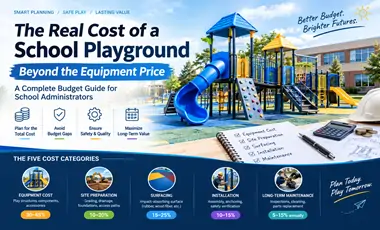
Budget planning for a playground goes beyond the purchase price. You need to account for several cost categories.
Cost components to consider:
Cost-saving tip: Some suppliers offer package deals that include equipment, surfacing, and installation. This can simplify procurement and potentially reduce overall costs.
Standard equipment may not fit your specific space, theme, or community needs. Customization allows you to:
Huaxia's design team has completed over 1,000 cultural products across outdoor cultural tourism, real estate communities, parent-child parks, and kindergarten education facilities. Custom solutions can turn a generic playground into a destination. Review the available outdoor play equipment configurations to see what's possible.
Many buyers overlook maintenance until problems arise. A proactive maintenance plan extends equipment life and reduces safety risks.
Essential maintenance tasks:
Huaxia's after-sales service includes a dedicated support hotline, online customer service, and repair personnel who can arrive at the site within 48 to 72 hours. They maintain over 500 types of common parts in stock, with regular parts typically delivered within about 2 days. They can also develop personalized maintenance plans based on equipment usage and characteristics.
The supplier you choose affects every aspect of your project—from design quality to after-sales support.
What to look for in a playground equipment supplier:
Huaxia offers a full industry chain solution: consulting, design, product development, production, construction, and after-sales service. Explore their park playground equipment range to see the quality and variety available.
Use this checklist to track your progress:
Mistake 1: Buying equipment before assessing the site. Equipment that doesn't fit your space or ground conditions leads to costly modifications.
Mistake 2: Ignoring safety standards. Non-compliant equipment creates liability risks and may not pass local inspections.
Mistake 3: Underestimating surfacing costs. Impact-absorbing surfacing is often one of the largest line items in a playground budget.
Mistake 4: Forgetting about maintenance. Without a maintenance plan, even the best equipment will degrade faster and become unsafe.
Mistake 5: Choosing the lowest price over total value. The cheapest equipment often has higher long-term costs due to repairs, replacements, and safety issues.
The timeline varies by project scope. A simple playground might take 4–8 weeks from design to installation. Complex custom projects can take 3–6 months or more. Factors include design complexity, manufacturing lead time, shipping distance, and site preparation requirements. If you have a specific timeline in mind, discuss your specific requirements with the supplier early in the process.
There is no single minimum—it depends on the equipment you choose. However, you should account for the equipment footprint plus safety clearance zones (typically 1.5–2 meters beyond equipment edges). A small playground for young children might fit in 50–100 square meters, while a large community playground could require 500+ square meters.
Ask for certification documentation from recognized testing bodies. For example, Huaxia's equipment is tested by German TUV and meets EN71 and EN1176 standards. Reputable suppliers will provide these documents upon request.
The best surfacing depends on the critical fall height of your equipment, your budget, and maintenance capacity. Options include rubber tiles (durable, low maintenance), engineered wood fiber (cost-effective, natural), and sand or pea gravel (affordable but requires regular raking and topping up).
Yes. Many suppliers offer custom design services. Huaxia's design team has completed over 1,000 cultural products across various sectors. Customization can include colors, shapes, branding elements, and educational features.
High-traffic public playgrounds should have visual inspections weekly and more detailed inspections monthly or quarterly. Low-traffic private playgrounds may need less frequent inspections but should still be checked regularly. Always follow the manufacturer's recommended inspection schedule.
Planning an outdoor playground is a multi-step process that requires careful consideration of site conditions, user needs, safety standards, materials, budget, and long-term maintenance. The most successful playgrounds are those planned with a clear understanding of these factors from the start.
Avoid the common mistake of jumping straight to equipment selection without doing the groundwork. Start with a site assessment, define your user group, and verify safety compliance before comparing products. And remember—the supplier you choose matters as much as the equipment itself.
If you're planning a playground project and want to explore equipment options, review the available outdoor play equipment configurations or contact the team to discuss your specific requirements.
Enter Your E-Mail


Yangwan Industrial Park, Qiaoxia, Yong Jia, Wenzhou, Zhejiang, China