Nov 12, 2026




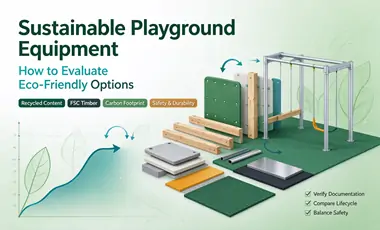
Sustainable playground equipment is not defined by a single label or marketing claim. It is determined by verifiable factors: the recycled or responsibly sourced content of materials, the durability and lifespan of the structure, the availability of end-of-life recycling, and the transparency of the supplier's environmental documentation. The most common mistake buyers make is accepting general eco-friendly claims without asking for specific evidence—recycled content percentages, FSC certification for timber, or lifecycle carbon data. This guide provides an evaluation framework so that sustainability can be assessed objectively alongside safety, durability, and cost.
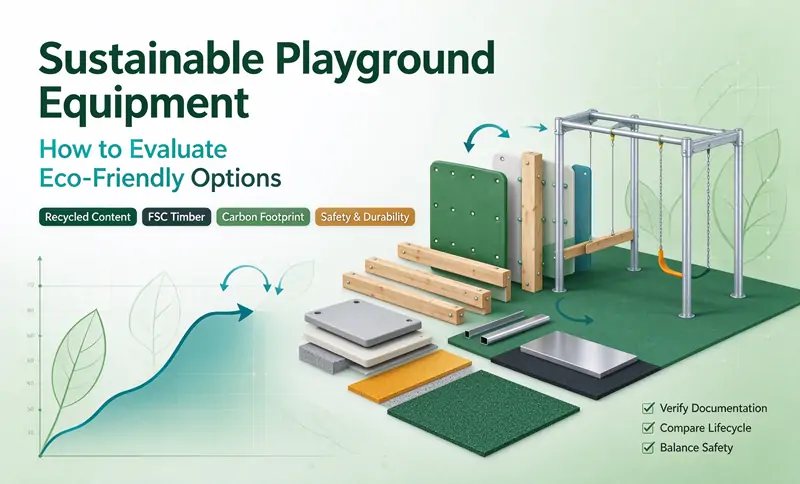
Sustainability in playground equipment operates on two levels: material sourcing and product lifecycle.
Material sourcing refers to how raw materials are produced or recovered. This includes:
Product lifecycle refers to what happens across the equipment's full life—from manufacturing energy use, through decades of service, to end-of-life recycling or disposal. A playground built from recycled materials but designed to last only eight years may have a higher lifetime environmental impact than a durable structure made from virgin materials with a 20-year service life.
A credible sustainability evaluation considers both dimensions, not just the recycled content on the material specification sheet.
Recycled high-density polyethylene, commonly known as HDPE, is one of the most established sustainable materials in playground equipment. It performs comparably to virgin plastic while diverting post-consumer waste from landfill.
What to verify:
Recycled HDPE is particularly relevant for panels, platforms, slides, and non-structural components. It does not rot, splinter, or require annual sealing—reducing both maintenance cost and the chemical inputs associated with timber upkeep.
Timber remains a common playground material, particularly for natural or nature-themed play environments. The sustainability question for timber is not whether wood is used, but where it comes from and how it is treated.
What to verify:
If your project requires sustainability certification, FSC-certified timber is the baseline specification, not an optional upgrade.
A growing number of suppliers publish carbon footprint data or Environmental Product Declarations for their playground products. These documents quantify the environmental impact across a product's lifecycle—from raw material extraction through manufacturing, use, and disposal.
What to ask for:
Carbon data is most useful when comparing products that serve the same function. A supplier that provides product-level verified data enables a fairer comparison than one that offers only qualitative environmental claims.
Recycled rubber from reclaimed tires is widely used in playground surfacing and molded components such as swing seats and spring rider bodies. Rubber mulch and poured-in-place rubber both incorporate recycled content.
What to verify:
Recent reviews of playground surfacing sustainability highlight concerns with conventional rubberized and synthetic surfaces, including thermal hazards and the presence of microplastics and other contaminants. Sustainable alternatives include permeable pavers, engineered wood fiber, and rubber-natural hybrid systems.
Evaluation criteria for sustainable surfacing:
These criteria should be assessed alongside the required impact attenuation rating for the equipment's critical fall height. Sustainability does not replace safety compliance—both must be verified.
Sustainability claims are easy to make and difficult to verify. The most reliable approach is to require documentation and compare it systematically.
Supplier sustainability checklist:
A supplier that can provide these documents is more likely to meet sustainability procurement requirements than one that relies on general environmental language. Requesting documentation also protects the buyer: if a claim cannot be verified, it should not be included in the project's sustainability reporting.
Sustainability is one criterion among several. It does not override safety compliance, structural integrity, or long-term durability.
A playground built from highly recycled materials but designed to last only a few years is not environmentally superior to a durable structure that serves for two decades. The most sustainable playground is one that remains safe, functional, and in use for as long as possible.
The practical balance:
Yes. Recycled content does not change safety requirements. Equipment must still meet ASTM F1487, EN1176, or applicable standards and carry certification from recognized bodies such as IPEMA or TUV. Always request the same safety documentation you would for any commercial playground product.
There is no single metric. Recycled content, FSC certification for timber, carbon footprint, durability, and end-of-life recyclability all matter. The most useful approach is to require documentation for each criterion and compare products on multiple dimensions rather than relying on one headline claim.
Quality recycled HDPE performs comparably to virgin HDPE and can last 30 to 50 years with minimal maintenance. Durability depends on UV stabilization, manufacturing quality, and the specific application. Ask for the UV stabilization grade, expected service life, and warranty terms.
Ask for the supplier's FSC chain-of-custody certificate number and confirm that the specific product uses certified timber. FSC certification provides independent verification that timber is traced through the supply chain to responsibly managed forests.
A growing number of suppliers provide product-level carbon footprint calculations or Environmental Product Declarations. Ask whether the calculation is verified by an independent third party and whether it follows recognized methodologies such as ISO 14040 or 14044. If product-level data is unavailable, treat general corporate claims with appropriate caution.
There is no universal answer. Recycled rubber offers durability and recycled content but may raise thermal and microplastic concerns. Engineered wood fiber is a natural alternative but requires maintenance and may not suit all accessibility requirements. Permeable pavers and hybrid systems are emerging options. The best choice depends on your safety requirements, climate, maintenance capacity, and sustainability priorities.
Evaluating sustainable playground equipment requires looking beyond general environmental claims to verifiable documentation: recycled content percentages, FSC certification, product-level carbon data, and recognized safety certifications.
The most important principle is to treat sustainability as a set of measurable attributes, not a marketing label. Request documentation for each criterion, compare suppliers on multiple dimensions, and balance environmental performance against safety, durability, and long-term maintenance.
If you are preparing a sustainable procurement project and want to review material and certification options, explore the available playground equipment configurations or contact the team to discuss your sustainability requirements.

Enter Your E-Mail


Yangwan Industrial Park, Qiaoxia, Yong Jia, Wenzhou, Zhejiang, China