Nov 23, 2026




Modern school playgrounds are no longer just places for physical exertion—they are outdoor classrooms. When children interact with sand, water, sound, and mechanical elements, they develop cognitive and problem-solving skills alongside physical strength. Integrating educational play elements into a school playground requires intentional design: selecting the right school playground equipment that supports STEAM (Science, Technology, Engineering, Arts, and Mathematics) concepts, natural sensory experiences, and unstructured play. This guide explains how to blend education with play, the features that drive cognitive development, and how to ensure these elements do not compromise safety.
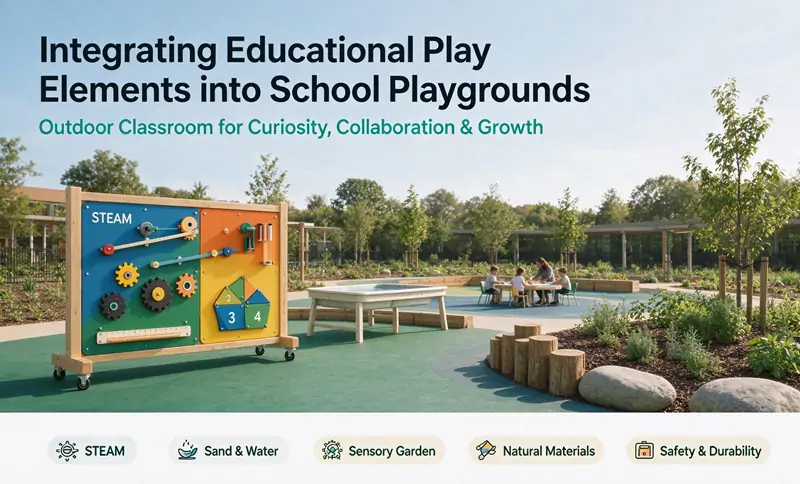
The concept of the "outdoor classroom" is gaining momentum because it addresses a core challenge in education: keeping students engaged while supporting their developmental milestones.
Traditional playgrounds often focus solely on gross motor skills (climbing, sliding, swinging). While these are essential, they leave a significant portion of a child's developmental needs—curiosity, experimentation, and problem-solving—unaddressed. Educational play elements bridge this gap. They turn the playground into a space where:
Research consistently shows that physical activity combined with cognitive challenge supports brain development. You can explore the developmental benefits of structured physical challenges in our guide to the benefits of outdoor obstacle courses.
Integrating education does not mean adding screens or digital devices. It means using physical, tangible elements that prompt exploration.
| Educational Category | Playground Features | Developmental Benefit |
|---|---|---|
| Physics & Engineering | Pulleys, gears, water pumps, balance scales | Cause and effect, mechanical advantage, problem-solving |
| Mathematics | Number panels, geometric shape sorters, abacus walls | Spatial reasoning, counting, pattern recognition |
| Acoustics & Music | Outdoor xylophones, talking tubes, drum panels | Auditory processing, rhythm, collaborative play |
| Nature & Biology | Sensory gardens, mud kitchens, bug hotels | Environmental awareness, tactile exploration, empathy |
| Imaginative Play | Themed structures, playhouses, stage panels | Social skills, language development, role-play |
When incorporating these features, suppliers often use modular designs. If your school requires specific themed elements or unique structures, understanding how the custom playground design process works can help you plan the production timeline.
Sand and water are perhaps the most universal educational play materials. They offer open-ended possibilities that adapt to any age group.
For schools, a combined sand and water zone (often called a mud kitchen) is highly effective. It encourages collaborative play and reduces sensory aversion in young children.
Educational playgrounds should not be entirely synthetic. Integrating natural elements (logs, boulders, planted areas) provides different tactile experiences and supports environmental education.
Design considerations for natural zones:
A common concern among school administrators is that adding educational features (like moving mechanical parts or water systems) introduces new maintenance and safety risks. This is a valid concern, but it can be managed through proper specification.
Educational features can add to the equipment cost, but they also increase the play value (the amount of time children spend engaged). A single high-quality interactive panel (like a sensory or water feature) can serve as the focal point of a play zone, reducing the need for additional standard play structures.
Proper drainage is essential. Water tables should be equipped with functional plugs and drainage lines that direct water away from the play area. Sand play areas should have a defined border and a geotextile membrane underneath to prevent weeds and soil mixing.
Yes. Many suppliers offer standalone educational panels (music walls, sensory tables) that can be installed as independent pieces alongside existing structures. This allows schools to retrofit older playgrounds with new learning features.
Integrating educational play elements transforms a standard school playground into a dynamic outdoor learning environment. By incorporating STEAM features, sensory gardens, and natural materials, schools can support both the physical and cognitive development of their students.
The key to success is ensuring that these educational features are built to commercial durability standards and comply with safety regulations. To see how these educational configurations can be adapted to your specific space and curriculum goals, review our playground equipment configurations. For project-specific guidance, contact the team to discuss your requirements.

Enter Your E-Mail


Yangwan Industrial Park, Qiaoxia, Yong Jia, Wenzhou, Zhejiang, China