Sep 29, 2026



The material used in playground equipment directly affects how long it lasts, how much maintenance it requires, and how safe it remains over time. Different materials perform differently under sun, rain, heavy use, and extreme temperatures. The key is to match material properties to your specific climate, usage intensity, and budget constraints. This guide compares the four most common playground equipment materials—galvanized steel, HDPE plastic, timber, and composite—so you can make an informed decision before purchasing.
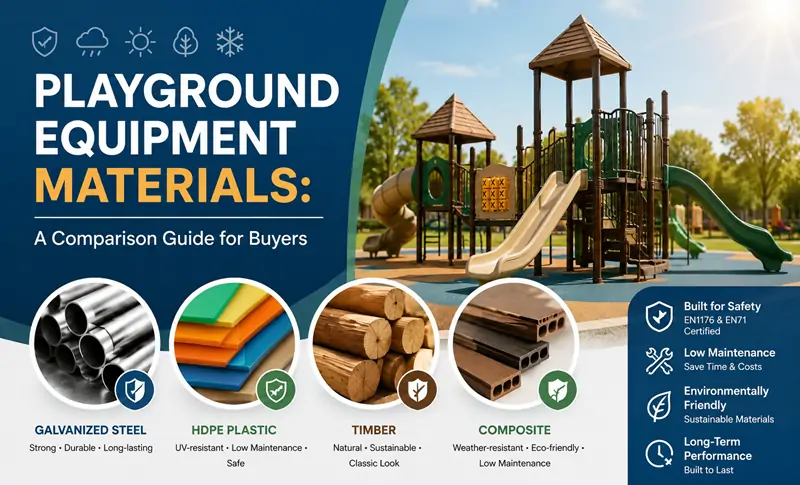
Most commercial playground equipment is made from one of four material types. Each has distinct advantages and trade-offs.
| Material | Key Properties | Best Suited For | Main Trade-off |
|---|---|---|---|
| Galvanized Steel | High strength, corrosion-resistant, long lifespan | High-traffic public parks, commercial settings, hot climates | Can get hot in direct sun; higher initial cost |
| HDPE Plastic | UV-resistant, colorfast, low maintenance, warm to touch | Daycare centers, schools, residential communities | May fade over many years; can be more expensive |
| Timber | Natural appearance, blends with environment | Nature-themed parks, eco-friendly projects, residential | Requires regular sealing and inspection |
| Composite (Plastic Wood) | Weather-resistant, low maintenance, eco-friendly | Coastal areas, high-humidity regions, sustainable projects | Lower load capacity than steel |
Huaxia uses environmentally friendly plastic wood, steel, and timber with anti-corrosion, waterproof, and anti-rust properties. Their commercial-grade equipment is built with 100% commercial-grade materials.
Galvanized steel is the industry standard for high-traffic commercial playgrounds. The steel is coated with a layer of zinc to prevent rust and corrosion.
Advantages:
Considerations:
For extreme environments like the Middle East and South America, hot-dip galvanized steel structures provide superior corrosion resistance against humidity and salt.
High-Density Polyethylene (HDPE) is a durable plastic widely used in playground equipment. It is known for its weather resistance and color retention.
Advantages:
Considerations:
Timber playground equipment offers a warm, natural look that blends well with outdoor environments. It is a popular choice for nature-themed parks and eco-conscious projects.
Advantages:
Considerations:
Huaxia uses timber with anti-corrosion, waterproof, and anti-rust properties to extend the service life of wooden equipment.
Composite materials combine wood fibers with plastic binders to create a product that looks like wood but performs more like plastic.
Advantages:
Considerations:
Climate is one of the most important factors in material selection. Different materials perform differently under various weather conditions.
Hot, Sunny Climates (e.g., Middle East, Southern US):
Humid, Coastal Climates (e.g., Southeast Asia, Caribbean):
Cold, Wet Climates (e.g., Northern Europe, Canada):
Temperate Climates (e.g., Western Europe, parts of US):
Material quality directly affects safety compliance. Reputable manufacturers test their materials to meet international safety standards.
Key standards to look for:
Huaxia's outdoor fitness equipment and outdoor slide products are tested by German TUV and meet EN71 and EN1176 standards. They also hold 5 invention patents, 27 utility model patents, and over 100 appearance patents.
What to ask your supplier about materials:
Maintenance requirements vary significantly by material. Understanding these differences helps with long-term budget planning.
| Material | Inspection Frequency | Typical Maintenance Tasks | Estimated Annual Maintenance Cost |
|---|---|---|---|
| Galvanized Steel | Quarterly | Check for rust, tighten bolts, clean surfaces | Low |
| HDPE | Semi-annually | Clean with mild soap, check for cracks | Very low |
| Timber | Quarterly | Seal/stain, check for rot/splinters, sand rough spots | Medium-High |
| Composite | Semi-annually | Clean, check for warping or damage | Low |
Huaxia's after-sales service includes personalized maintenance plans based on equipment usage and characteristics, with regular inspection, cleaning, lubrication, and fastening work to prevent failures and extend service life. They maintain over 500 types of common parts in stock, with regular parts typically delivered within about 2 days.
The purchase price is only part of the total cost of ownership. Material choice affects long-term costs in several ways.
Total cost of ownership factors:
For commercial settings with high traffic, investing in durable materials like galvanized steel or HDPE typically results in lower total cost of ownership over the equipment's lifespan, despite higher upfront costs.
Use this checklist to guide your material decision:
Mistake 1: Choosing based on initial price alone. The cheapest material often has the highest long-term maintenance and replacement costs.
Mistake 2: Ignoring climate. A material that works well in a temperate climate may fail quickly in a tropical or desert environment.
Mistake 3: Underestimating maintenance. Timber requires regular attention. If you don't have the staff or budget for maintenance, choose a lower-maintenance material.
Mistake 4: Not verifying certifications. "Commercial-grade" is not a regulated term. Always ask for third-party test documentation.
Mistake 5: Forgetting about user comfort. Metal gets hot in the sun; plastic stays cooler. In hot climates, consider user experience alongside durability.
Galvanized steel typically offers the longest lifespan—20 years or more with proper maintenance. HDPE also lasts 15–20 years. Timber generally lasts 10–15 years, and composite falls in between. Actual lifespan depends on climate, usage, and maintenance.
Yes. HDPE is food-grade safe, BPA-free, and widely used in children's products. It is tested to meet EN71 and EN1176 safety standards. Huaxia's HDPE equipment is UV-protected and designed with rounded edges and anti-slip surfaces for safety.
Use powder-coated or UV-reflective finishes, install shade structures over equipment, or choose HDPE for components that children touch frequently. In extreme heat, some operators restrict use during peak sun hours.
Galvanized steel requires minimal maintenance—primarily periodic inspection for rust at welded joints and bolt points, cleaning to remove dirt, and tightening of hardware. Unlike timber, it does not require sealing or painting.
Yes. Many HDPE and composite products are made from recycled plastics and wood fibers. Huaxia uses environmentally friendly materials and offers eco-friendly options. Ask your supplier about the recycled content of their products.
Request certification documentation from recognized testing bodies. Huaxia's products are tested by German TUV and meet EN71 and EN1176 standards. Reputable suppliers will provide these documents upon request.
Choosing the right material for playground equipment requires balancing durability, maintenance, climate suitability, and budget. Galvanized steel offers the longest lifespan and highest strength, making it ideal for high-traffic commercial settings. HDPE provides excellent weather resistance with minimal maintenance. Timber delivers a natural aesthetic but requires ongoing care. Composite offers a middle ground between wood appearance and plastic durability.
The best choice depends on your specific conditions—climate, expected usage, available maintenance resources, and aesthetic requirements. Always verify material certifications and ask suppliers about performance in your local climate.
If you're evaluating playground equipment options and want to explore material choices in more detail, review the available playground equipment configurations or explore commercial-grade equipment designed for high-traffic environments. For project-specific guidance, contact the team to discuss your requirements.
Enter Your E-Mail


Yangwan Industrial Park, Qiaoxia, Yong Jia, Wenzhou, Zhejiang, China