Sep 18, 2026




Outdoor play equipment for a daycare setting must meet a standard that backyard toys do not. The structures must be low enough for a two‑year‑old to climb safely, open enough for caregivers to supervise multiple children at once, and durable enough to survive daily use through rain, sun, and the kind of enthusiastic handling that only toddlers can deliver. At the same time, the equipment should encourage the gross motor development, sensory exploration, and social interaction that are central to early childhood education.
The five configurations below are based on equipment commonly installed in childcare centres and preschools. Each one addresses a different aspect of young children's physical and cognitive development, and all are designed with the safety clearances, guardrails, and impact‑absorbing surfacing that daycare licensing standards require.
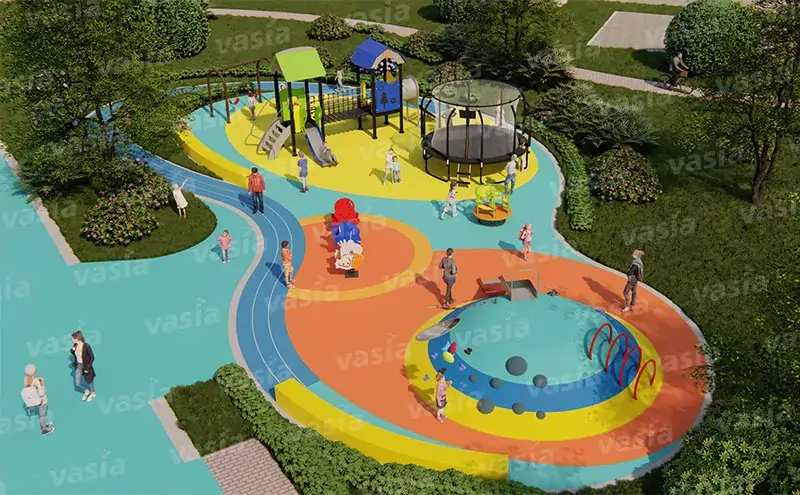
A compact structure with a platform height of 1.2 metres or less, a gentle slide, and a few climbing challenges – a short ramp with hand grips, a set of wide, shallow steps, or a small tunnel – gives toddlers a safe way to build balance and coordination. The guardrails should be continuous and spaced to prevent head entrapment, and the slide should have a long, flat run‑out so children can come to a natural stop without a sudden drop.
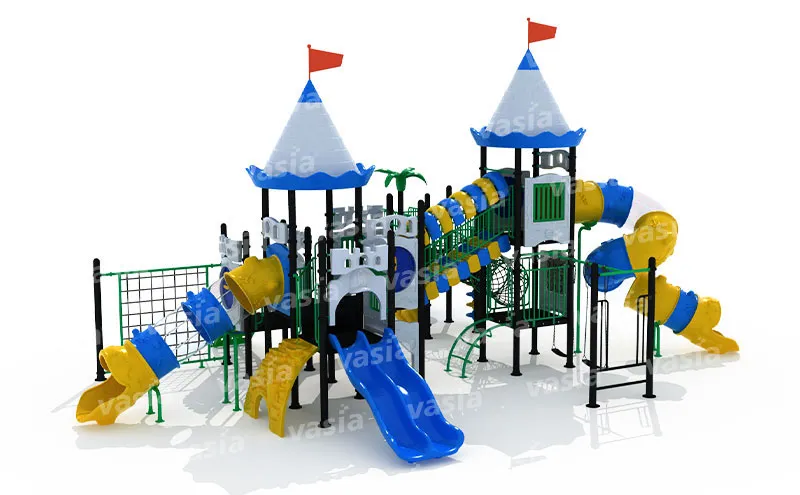
This type of configuration is often the centrepiece of a daycare playground. It works best when the structure is accessible from all sides so that several children can use it at once without queuing. For a daycare looking for a ready‑made, child‑scaled play unit, Vasia's outdoor plastic play castle integrates slides, platforms, and climbing features in a single structure designed for early childhood settings.
Young children learn through touch, sound, and sight. A sensory zone can include sand and water tables at toddler height, musical play panels (xylophones or drum panels mounted on a frame), textured paths with different surface materials, and outdoor chalkboards or whiteboards mounted at ground level. These elements encourage fine motor development, language skills, and cooperative play without requiring the physical risk that climbing structures entail.
Sensory zones are also an effective way to include children with mobility limitations or sensory processing differences, because many of these activities can be accessed from a seated position. The equipment should be installed at ground level with smooth, non‑porous surfaces that can be disinfected daily – a requirement that has become standard practice in childcare facilities.
A small playhouse, a miniature shopfront, or a train‑shaped structure provides a stage for imaginative play. Two‑ to five‑year‑olds spend a significant portion of their outdoor time engaged in role‑playing scenarios – cooking, driving, selling goods – that build social skills and language. Pretend play structures work best when they are partially enclosed to create a defined "room" or "vehicle" that children can occupy, and when they are positioned near other activity zones so that the role‑play can spill over into the climbing and sensory areas.
The materials must withstand being climbed on, even though the structure is designed for ground‑level use. Plasticised wood or UV‑stabilised HDPE panels hold their colour and resist cracking under sun exposure, which is important for outdoor daycares that cannot cover their equipment during the day. Structures like a themed plastic play castle for outdoor daycare use provide the enclosed, imaginative space that toddlers gravitate toward while meeting the durability standards required for commercial childcare.
A short obstacle course – stepping stones at ground level, a low balance beam, a row of stumps set into the safety surfacing – provides a challenge that children can repeat dozens of times. Repetition builds the neural pathways for balance and coordination, and children naturally seek out activities that allow them to practise a skill until they master it.
The elements should be spaced so that a child can step from one to the next without jumping, and each element should be no higher than 20–30 cm to keep falls within the capability of the safety surfacing. A balance trail takes up less space than a large climbing structure, which makes it a practical addition to daycares with a limited outdoor area.
Not every child wants to run and climb. A shaded corner with a small bench, a ground‑level planter box for digging, and a few soft‑play elements gives children a place to retreat when they are tired or over‑stimulated. This area should be visible from the main play zone so that a caregiver can supervise both simultaneously.
A shade sail or a permanent roof structure is recommended, especially in regions with high UV exposure, because young children's skin is particularly sensitive to the sun. The ground surface under the quiet area should be the same impact‑attenuating material as the rest of the playground to allow children to move freely between zones without changing surface type.
When selecting any of the above configurations, four factors matter most for a childcare setting:
Age‑appropriate dimensions. Platform heights should be 1.2 m or lower for children under five. Grip diameters should be small enough for a toddler's hand, and step heights should not exceed 15 cm.
Material and maintenance. Equipment that sits all day outdoors must resist UV, moisture, and frequent cleaning with disinfectant. Hot‑dip galvanised steel frames with HDPE plastic panels are the standard for commercial daycare equipment.
Safety certification. The equipment should be tested to EN 1176 or ASTM F1487, and the supplier should provide the test reports. The safety surfacing – whether rubber tiles, poured‑in‑place rubber, or engineered wood fibre – must meet the critical fall height of the tallest structure on the site.
Supervision sight lines. The layout should allow a caregiver standing at one or two vantage points to see every part of the playground. Solid panels that block visibility should be minimised, and structures should be positioned so that children are never hidden from view.
A daycare that incorporates all five of the above configurations – a low‑level climber, a sensory zone, a pretend play structure, a balance trail, and a quiet corner – provides a rich, varied outdoor environment that supports every area of early childhood development. The configurations can be scaled to the available space and budget, and they can be installed in phases as the facility grows.
For daycare operators starting a new project or upgrading an existing playground, working with a supplier that understands the specific requirements of early childhood settings – low platform heights, toddler‑scaled grips and steps, and materials that survive daily cleaning – reduces the risk of ordering equipment that looks good in a catalogue but does not meet licensing standards. A well‑designed daycare playground is an investment in the children's development and in the reputation of the centre.

Enter Your E-Mail


Yangwan Industrial Park, Qiaoxia, Yong Jia, Wenzhou, Zhejiang, China