Oct 20, 2026



The first thing you notice on an early morning playground visit is the dampness. Dew clings to the monkey bars, and a faint line of rust has started to creep along a bolt head that looked pristine just six months ago. Across the park, a fiberglass slide has dulled to a chalky white, its glossy finish surrendered to the sun. For municipalities, school districts, and even homeowners, these are expensive, frustrating headaches. But what if the problem isn't the weather itself — it’s the design decisions made long before the equipment was installed?
Making sense of weather endurance starts with understanding the real mechanisms of degradation, and the smart solutions that have evolved to counter them.
A common belief is that frequent rain or blazing sun inevitably destroys any structure left outdoors. In practice, however, seasoned maintenance crews and installers notice a different pattern. The damage isn’t caused by getting wet; it’s caused by staying wet. Standing water trapped in crevices, moisture wicked into untreated end-grain of wood, and condensation inside hollow steel tubes account for the vast majority of premature failures. Similarly, UV radiation isn’t a uniform menace — it attacks surfaces that lack sacrificial protection and are oriented at exactly the wrong angle to the southern sky.
Engineers who specialize in long-life outdoor structures now approach weather resistance as a three-layer problem: material selection, surface treatment, and drainage-focused geometry. Missing any one of these layers leaves the structure vulnerable, even if the other two are done well.
Material choice is the first — and most irreversible — decision. While initial cost always plays a role, the long-term economics look very different once you factor in replacement cycles, liability from equipment failure, and safety surfacing that must be torn up to swap out a post.
Galvanized steel remains the workhorse for structural frames. The hot-dip galvanizing process, governed by standards like ASTM A123, creates a metallurgically bonded zinc-iron alloy layer that can withstand decades of exposure in non-marine environments. For coastal installations with high salt loads, some specifiers are shifting toward stainless steel grades 304 or 316, especially for fasteners and chains, where pitting corrosion can hide out of sight until it becomes a safety issue.
Then there’s high-density polyethylene (HDPE) for panels, roofs, and slides. Unlike the brittle plastics of two decades ago, modern UV-stabilized HDPE contains carbon black or specialized UV absorbers mixed directly into the resin — not painted on the surface. That means scratches don’t expose unprotected material. The material also doesn’t absorb water (typically less than 0.01% by weight after 24-hour immersion per ASTM D570), so freeze-thaw cycling is a non-issue.
For wooden elements, pressure-treated southern yellow pine with retention levels of at least 0.40 pcf (for ground contact) can deliver a service life of 20+ years. But the critical detail, often skipped by DIY builders, is field-treating every cut end with a copper naphthenate solution. Untreated cuts create a highway for moisture and decay fungi straight into the heart of the timber.explore weather-resistant construction methods
Even the best base material benefits from a secondary barrier. Powder coating on steel is arguably the most visible and most misunderstood layer. The key metric isn’t just film thickness — it’s cross-hatch adhesion (tested per ASTM D3359) and salt spray resistance (ASTM B117). A quality polyester or polyester-TGIC powder coat with proper pretreatment (zinc phosphate wash, followed by a chrome-free zirconium conversion coating) can survive 1,000+ hours in a salt fog chamber without underfilm corrosion creeping from a scribed line.
A detail that separates premium installations from average ones: edge coverage. Powder naturally thins on sharp corners, leaving those edges electrically vulnerable. That’s why the most durable designs radius all edges, or they add a final translucent seal coat. If you’re evaluating equipment, run your fingers over a sample — if the edges feel sharp, the coating is almost certainly thinner there.
For wooden components, water-repellent stains with mildewcide packages outperform film-forming paints. Paints crack and trap moisture behind the film; penetrating stains allow the wood to breathe and are easier to recoat without laborious stripping. The USDA Forest Products Laboratory has repeatedly documented this advantage in field exposure studies.
Some of the most effective weather defenses are invisible to playground visitors because they’re built into the geometry of the equipment. These design strategies ask one simple question: how does water leave the system?
Sloped surfaces and drip edges: Horizontal surfaces are rare in well-engineered play structures. Roofs, platforms, and even decorative panels are pitched a minimum of 3 degrees to prevent ponding. Where slope isn’t possible, a drip groove or lip cuts the surface tension path so water doesn’t crawl underneath.
Weep holes in tubular components: Vertical posts set in concrete are a classic weak point. Industry standard practice now includes a drainage hole at the base of all enclosed tubes, allowing condensation (which forms inside on humid days) to escape rather than accumulating.
Isolation of dissimilar metals: Where aluminum fittings contact steel, a nylon or EPDM washer breaks the galvanic circuit. Without it, the less noble metal (aluminum) corrodes sacrificially at an accelerated rate, leading to loose joints within a single wet season.
End-cap design for plastic parts: Injection-molded HDPE posts and panels use labyrinth-style caps that shield the open cell structure at cut edges. These caps are designed with internal standoffs so that even if water enters the cap, it makes no prolonged contact with the edge.
These principles are widely known in the playground industry, but their execution varies dramatically. A telling indicator of quality is whether the manufacturer’s engineering documentation includes water-management logic, or whether it treats everything as a solid mass that simply "should hold up."
Even the most brilliantly engineered installation still needs periodic attention. The good news is that weather-resistant design directly reduces the maintenance burden. A five-year field study by a large U.S. parks department found that playgrounds built with HDPE panels, galvanized steel, and properly sloped drainage required 60% fewer maintenance man-hours over that period compared to systems relying on painted steel and ungraded timber.
A pragmatic seasonal checklist can stretch longevity further:
Spring walkthrough: Look for any fasteners that have loosened due to freeze-thaw cycling. Check that weep holes are unobstructed by mulch or insect nests.
Summer UV check: Inspect plastic slides and panels for any chalky residue — this signals the UV package may be nearing end of life, even if the panel is still structurally sound.
Fall drainage audit: Remove leaf litter from any corners or roof sections where water might begin to collect. Verify that ground drainage beneath the equipment hasn’t shifted, creating mud pockets around posts.
Winter bolt torque verification: Cold contraction can relax the clamping force on certain bolted assemblies. A quick check with a calibrated torque wrench catches issues before they become play-related hazards.
This routine shouldn’t be seen as a design failure; it’s the equivalent of changing the oil in a vehicle. Even the best materials operate in a harsh environment, and consistent, low-effort monitoring is what turns a 15-year structure into a 25-year structure.
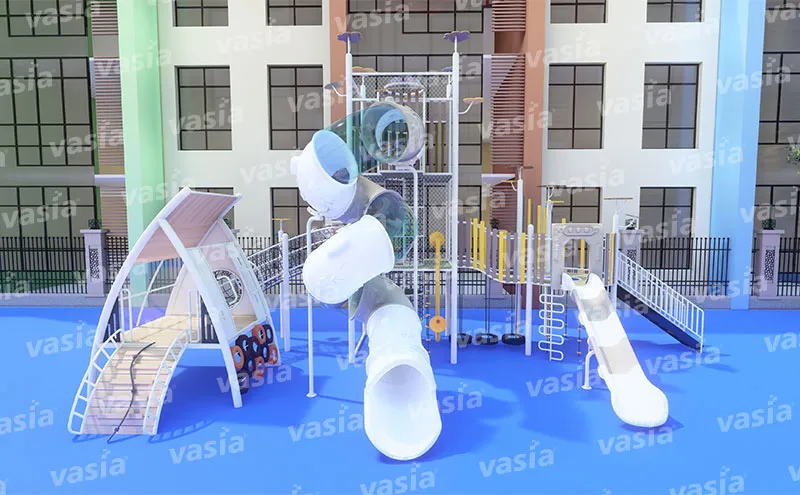
Selecting a playground or backyard play structure is often driven by visible features — the height of the slide, the number of swings, the bright color palette. But the real story of whether that equipment will still feel inviting and safe five years later lives in the details described above. When materials, coatings, and drainage are designed as an integrated system from the start, weather resistance stops being a marketing checkbox and becomes something you never need to think about.
If you’re evaluating options for a community space, a school, or a home setting that demands long-term durability without compromising on aesthetics, it’s worth looking closely at the engineering rationale behind each design. How are the posts terminated? What adhesion standards are referenced for the powder coating? Are the plastic components UV-stabilized throughout their thickness?
These are the kinds of questions that separate a considered, long-life installation from one that looks great for the first year and slowly begins to show its age. For those who want to skip the trial-and-error phase and see a system where these protections are designed in from the ground up, Huaxia’s range of recreational structures reflects the kind of integrated durability thinking that makes a tangible difference over time.

Enter Your E-Mail


Yangwan Industrial Park, Qiaoxia, Yong Jia, Wenzhou, Zhejiang, China