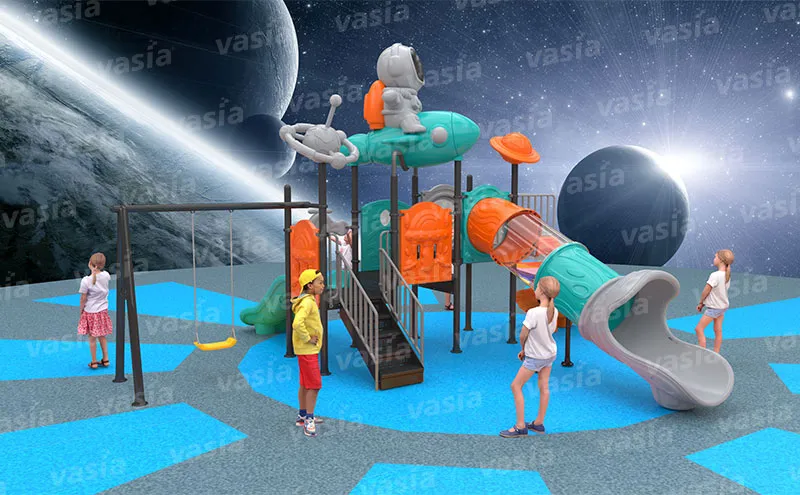
Oct 08, 2026




If you're reading this, you're probably not just "shopping" – you're trying to solve a puzzle with a hundred moving pieces. You need something that won't rust through after two winters, won't give the insurance adjuster heart palpitations, and actually gets kids to look up from their screens. The single most important piece of advice I can give before you spend a dollar: stop looking at catalog pictures first. Start with the site survey and the use zone. Most buyers walk into this process backward – they fall in love with a towering spiral slide, then realize their available footprint is 20 feet too narrow and the fall height would require surfacing that blows half the budget. So before we dive into the nuances of metal gauges and modularity, let's establish that outdoor playground equipment is a long-term infrastructure investment, not a retail impulse buy. Get the groundwork right, and the rest follows .
I've watched a community group in the Midwest raise funds for three years only to discover their chosen site had drainage issues that would have submerged the swing set every spring. Don't be that group. Let's walk through this systematically.
Here's a cold truth: the most beautiful play structure in the world is a liability nightmare if it doesn't meet the baseline. If you're in North America, you need to be fluent in ASTM F1487 and the CPSC Public Playground Safety Handbook. The CPSC updated its guidance recently – the first major refresh since 2010 – tightening the language around entrapment hazards, protrusion gauges, and fall zone dimensions .
What does this mean in plain English? It means you can't just eyeball the gap between the platform and the guardrail. Head entrapment is a specific, measurable risk: any opening between 3.5 and 9 inches is a red flag. You want either smaller (to trap nothing) or larger (to let everything pass through). No middle ground.
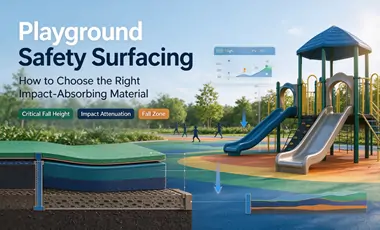
Surfacing is not decoration. You'll see numbers like "critical fall height" in spec sheets. That 8-foot deck requires surfacing that absorbs impact from 8 feet – not 6 feet of wood chips fluffed up to look thick. Engineered Wood Fiber (EWF) , Poured-in-Place (PIP) rubber, or rubber tiles – each has a maintenance profile. EWF looks natural and costs less upfront, but it decomposes, compacts, and needs annual top-offs. PIP is smooth and ADA-friendly, but it's expensive and a nightmare to repair if the substrate cracks. Factor in the lifecycle cost, not just the install bill .
Let's talk about the stuff you actually touch. For the bones of the playground set – the posts, decks, and rails – you're largely choosing between galvanized steel and recycled structural plastic (HDPE) .
Steel has come a long way. Look for G90 galvanization or, better yet, powder-coated galvanized steel. Raw painted steel over untreated metal is a rust bucket waiting to happen, especially if you're within 50 miles of a coast or in the snowbelt where road salt drifts over. I've seen playground posts in coastal Maine look like crumbling Roman ruins within five years because someone cheaped out on the coating spec.
Recycled HDPE is the quiet overachiever. It doesn't rot, it doesn't splinter, and termites look at it with confusion. It also doesn't get surface-of-the-sun hot like dark metal slides in July. That's a real play value consideration: a child with a second-degree burn from a scorching slide isn't coming back. For climbers and roofs, I lean heavily toward HDPE or rotationally molded plastic for the same reason.
Then there's fasteners. This is the kind of detail that makes maintenance supervisors either love you or curse your name. You want tamper-resistant hardware. Not standard hex bolts that a bored 12-year-old with a multi-tool can remove for fun. Look for security Torx or pinned hex fasteners. It sounds paranoid, but I've seen entire panels of activity boards vanish from community parks overnight.
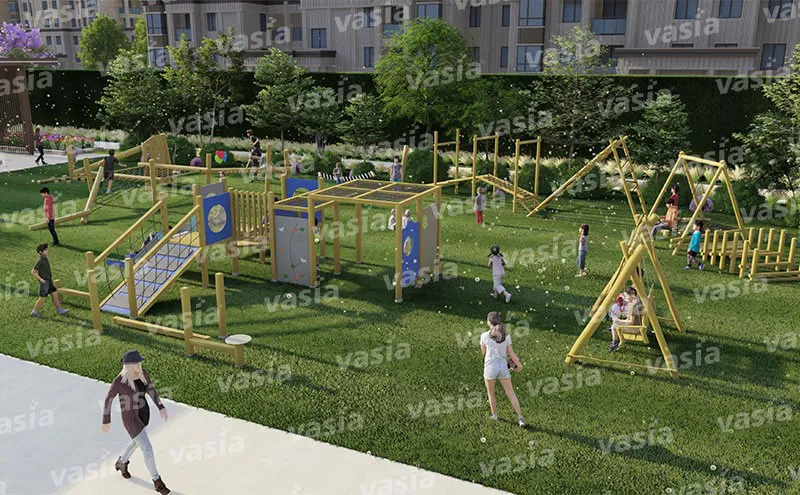
We've covered safety and durability. Now the fun part: play value. This is where a lot of well-meaning adults miss the mark. Adults see a modular play system and think, "That looks neat and tidy." Kids see a series of transitional platforms and predictable slides and think, "I'm bored, let's go find a stick."
Loose parts theory – the idea that the more variables children can manipulate, the richer the play – should guide you. You don't need to scatter loose junk everywhere, but you do need emergent play opportunities. A storefront panel, a steering wheel that actually spins, a telescope pointed at nothing – these are imagination ignition switches.
Look for asymmetry in the design. A structure where the only way up is a set of stairs and the only way down is a straight slide is a one-act play. Add a curved tube slide, a pod climber, a transfer station, and suddenly it's a labyrinth. The dwell time increases because the route isn't obvious. For schools, this matters: kids who are deeply engaged in cooperative play have fewer behavioral incidents.
Inclusivity isn't a ramp. Yes, an accessible ramp to the main deck is required for ADA compliance. But a child in a wheelchair or with mobility issues doesn't just want to sit on a platform and watch. Look for ground-level play components: musical instruments (drums, chimes), sensory panels, or a Sway Fun glider that lets wheelchairs roll right on. The Benjamin Wax Community Park project spec I reviewed recently explicitly required sensory play devices and educational panels at transfer height – that's the new baseline for public projects .
You might think customized playground design is only for theme parks with seven-figure budgets. That's outdated thinking. Modern modular manufacturing allows for semi-custom solutions that don't break the mold (literally).
Why bother customizing? Because a generic primary color play unit in a town known for its historic red brick and oak trees looks like a misplaced fast-food toy. I've seen projects where the shade structure echoes the roofline of a nearby community center, or the climber mimics a local geological feature. This contextual design makes the playground feel like it belongs. It becomes a destination playground, not just a neighborhood tot lot.
If your site has sloped terrain, a cookie-cutter system forces expensive grading and retaining walls. A manufacturer that offers variable post lengths and custom deck heights can let the structure hug the contour of the land. You save on excavation costs and gain a more dynamic, interesting landscape.
Customization also extends to branding. For a school, incorporating mascot colors into the powder coat or adding a custom entrance arch builds school spirit. For a commercial childcare center, unique theming is a differentiator that justifies premium tuition. When evaluating a supplier's capabilities, you might want to explore the range of modular accessories available to see how standard components can be combined in unexpected ways.
This is the spreadsheet section. If you're buying for a school district or municipality, the upfront capital expenditure is only chapter one. The rest of the book is operations and maintenance (O&M) .
Let's break down the total cost of ownership with real numbers. If you're budgeting $150,000 for equipment and $30,000 for installation/surfacing ($180,000 total), you should be setting aside 5-10% of the initial equipment cost annually for maintenance . That's $7,500 to $15,000 per year for a professional maintenance plan (PMP). Why professional? Because a certified playground safety inspector (CPSI) catches the fatigue cracks in a weld or the S-hook gap on a swing before it becomes a loss of limb or a liability claim.
Skipping this is a false economy. Equipment that should last 15-20 years with a preventative maintenance schedule will be condemned in 8-10 years without it . You lose that amortization sweet spot where the structure is paid off but still serviceable. Those extra 5-7 years are pure value capture.
If the upfront capital is a hurdle, look at phased installation. Buy the core play structure now, with footings prepped for the swing bay or climbing boulder next fiscal year. Just ensure the use zones for future phases are kept clear. And check if the vendor offers leasing options or partners with grant writers – many do, but they won't volunteer it unless you ask.
Finally, weigh the installation model. Factory-direct install crews are expensive but typically ensure warranty compliance. Volunteer builds (common in communities) save money but require a certified installer to supervise and sign off. If a bolt is over-torqued by a well-meaning dad with an impact driver, you can strip the threading in the recycled plastic post and compromise the structural integrity. That's a $500 post you just turned into scrap.
A Final Thought on Value
Choosing playground structures is an exercise in balancing immediate joy with long-term stewardship. You're not just buying steel and plastic; you're buying risk mitigation and childhood development infrastructure. For those navigating this process for a community or educational facility, taking the time to review a complete component catalog can reveal options you didn't know existed – elements that turn a standard playground into a community landmark. The right choice doesn't shout the loudest on opening day; it stands silent and sturdy for the 15th graduating class that runs across its decks.

Enter Your E-Mail


Yangwan Industrial Park, Qiaoxia, Yong Jia, Wenzhou, Zhejiang, China